17 September 2011

The Dagger, Or Obelisk: A Typographic Enigma


In this post, I introduce you to the shadowy, enigmatic underworld of fringe typography. No, I do not refer to the intriguingly-named interrobang or pilcrow, nor of the asterism.*  Today I speak of the dagger (†), also known as the obelisk, and its companion the double dagger (‡), also known as the dieses. Perhaps you have encountered the dagger, or obelisk, following the end of a sentence.  You might have asked yourself, What could this strange mark signify? But, lo! its companion lurks at the bottom of the page, in the footer, or maybe at the end of the chapter, hiding in the endnotes.  Why not just use numbered footnotes, you say? Why, where's the fun in that?


The name "obelisk" comes from the Ancient Greek obeliskos, meaning "little obelos."  Obelos was the word for "roasting spit," and could also mean a javelin or dart. The original symbol was closer to our modern division sign (÷).  This mark was used, appropriately, when scholars were editing -- or "skewering" [Ed.: Ha!] -- a manuscript to indicate a passage to strike out.  This editing was (and is) called obelism, and the Greek version included such annotations as the coronis to indicate subsections, the paragraphos to show breaks between, well, you know, and the hypodiastole for spaces (which hadn't been invented yet).


Neither the obelisk nor dagger (nor double dagger!) of which I speak.

Legend has it that the obelisk was invented by third-century B.C. Greek Zenodotus, a Homeric scholar who was also the first head librarian at the famous Library of Alexandria.  He mostly used the obelisk to mark lines from Homer that were of dubious attribution, (although he left in all those tedious "wine-dark sea" bits). In addition to creating interesting typographical novelties, Zenodotus, in his capacity as librarian, came up with the first real library catalog organization scheme, direct ancestor of our modern Dewey decimal system, Library of Congress Catalog system, etc.  He categorized books (scrolls) by subject, putting all texts on similar topics in the same room.  Within each room, he filed the manuscripts alphabetically by author.  Zenodotus also had each scroll marked with a tag that gave its basic bibliographic information.  It must be said, this guy had a benevolent genius! Whether he was constantly irritated by patrons with simple, obvious questions has went unrecorded.  


The Library of Alexandria, ancestral home of the dagger and general typographical nursery. In this photo, library slaves re-shelve "books" (R), while Learned Greek Expats like Zenodotus discuss punctu-innovations (L).

The obelisk was refined further by Zenodotus' student, Aristophanes of ("Before it Was Big") Byzantium (257-180 BC), who also invented the comma and colon; and his student, Aristarchus of Samothrace (220-143 BC), who probably was responsible for the dividing of the Odyssey and Iliad into books and ruining literature classes for students for milennia to come.† A later fan of the dagger/obelisk was OG Christian scholar and fellow-Alexandrian Origen (184-253 AD), who used it while compiling his Biblical boxed set, the Hexapla


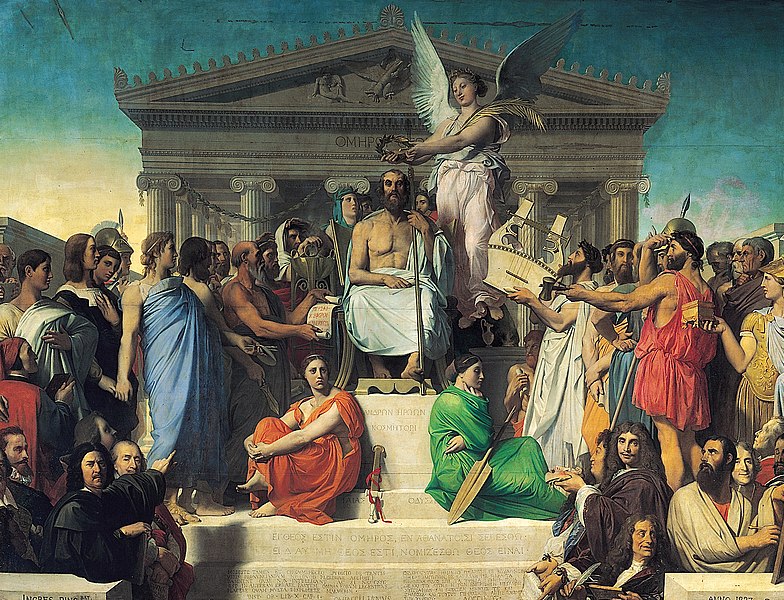
The great typographical critic Aristarchas of Samothrace, as imagined by 19th-century French artist and hater of criticism Jean-Auguste-Dominique ("Le Jad") Ingres (1780-1867) in his painting Apotheosis of Homer (detail of Aristarchus on right).  


So what is the dagger used for today? Not a hell of a lot, if you compare it with its glory days in Greek Alexandria. But the obelisk is still out there, if you know where to look, and is not to be found just in informal footnotes: 
  • In genealogical records, such as family trees, the dagger is used to indicate the death, or the unnatural death, of a person. Similarly, in biology, it is used to note the extinction of a species, genus, etc., especially if it was decimated entirely with spears, like our woolly friend the mammoth.  
  • In physics, and sometimes maths, it is used to indicate the Hermetian adjoint of an operator, whatever that means. I do know that the Hermetian adjoint was invented by Charles Hermite, 19th-century French mathematician and probable hereditary hermit /misanthrope, and who, among other things, had a club foot, contracted smallpox but lived, and communicated with others, it was said, in cryptic statements like, "I turn with terror and horror from this lamentable scourge of continuous functions with no derivatives," and "I shall risk nothing on an attempt to prove the transcendence of Pi."  
  • In cricket, the dagger is used on the scorecard to represent the team's (probably living) wicket-keeper.  
  • It is used to indicate obsolescence of a word (as in the Oxford English Dictionary). This is in keeping with the dagger's unfortunate association with death and extinction. :( 
Well, Friends of the Cabinet, I could go on taking about the dagger all day (probably not, I'm about out of material), but I must take my leave.‡  I hope you've enjoyed our sojourn through typography past and present.  
_________________________________________________________________


*     The Discerning Reader knows that each of these rare symbols deserves its own post.
†     Your Humble Scribbler feels that there should be a moratorium on reading these foundational works of the Western canon for at least a century.  He had to read the Odyssey at least five different times during his secondary and university education.  
‡     Your Humble Scribbler just threw this note in to complete the * -  † - ‡ footnote cycle.  Sorry, Readers hoping for a genuine and enlightening footnote.

29 August 2011

The Legend of Dick Whittington & His Celebrated Cat


Left: A 1617 engraving of Richard Whittington by Renold Elstracke (National Portrait Gallery, London). A printer altered the engraving, originally showing Whittington holding a skull, to include his famous cat. 

Right: "Portraits of Sir Richard Wittington and his Cat, from an Original Painting at Mercers Hall" (From The Wonderful Museum, 1808).  


Hello! Perhaps you thought I had abandoned you, Gentle Readers, because of my lengthy absence from this Forum of Rarefied Discourse.  Or maybe you didn't even notice, but no matter - your Prodigal Blogger has returned!  
Today, I bring you the tale, long promised but hardly expected, of the legendary professional cat-fancier Sir Richard Whittington (1354-1423), four-time Lord Mayor of London and Member of Parliament, Knight of the Realm, etc., etc. A generous, charitable man, upon his death, his vast fortune went to the foundation of the Charity of Sir Richard Whittington, which operates to this day.
Too bad a heartwarming and possibly magical feline friend he purportedly owned as a boy obscures these actual achievements and good deeds! The legend, bandied about in England's pleasant pastures green since the fifteenth century, runs thus:

Dick (Richard Whittington) is an impoverished orphan boy from Gloucestershire in the English countryside.  Making his way picaresquely to the "gold-paved" streets of the Capital, London, Dick finds not gilded metropolitan pavers but only more hard times.  


Dick, dressed smartly in Merry Man attire, rests his bindle on the road to London.
(From Flora Annie Webster Steel's English Fairy Tales, 1918.)


Taken in by a wealthy merchant, a certain Fitzwarren ("Bastard son of some guy named Warren"), Dick gains employment as a servant but also discovers his quarters are infested with rodents. [Ed.: Bubonic Plague a-comin'!]  What can a poor boy do?

To combat this pestilence, Dick buys a cat with his meager earnings.  [Ed.: Did one really have to BUY cats during the Middle Ages? I could walk outside my home right now and get one for free!]  Seemingly the cat rid Dick's hovel of rodents, or at least left his room scattered with dead mice. 

Dick shows off new his cat to some people in snazzy, fabric-heavy clothes (presumably Fitzwarren and his daughter Alice). As our hero would soon discover, girls love men with wealth-producing cats.  

Yet Dick inexplicably donates his cat to a ship that his cruel master "Bastard" Fitzwarren is sending on a trading expedition to the Barbary States of North Africa. Everyone in the Fitzy household is expected to contribute something to trade for gold, and the cat is judged Dick's only possession that a Berber might want. After several more months under the boot of Mr. Fitzwarren and his malevolent servants, Dick decides to run away from his job and from London. But, before he can, he hears some magical church bells (from St. Mary-le-Bow) that seem to say, "Turn again Whittington, thrice Lord Mayor of London." Catchy!  

Running back to Fitzwarren's, he discovers that the trading ship had returned. Moreover, his nameless cat had been sold to the King of Barbary for a fortune in gold, because the palace was overrun my mice! Now possessing a fortune, because Fitzwarren inexplicably gave all the gold from a trading venture he solely financed directly to a boy, without taking a cut, Dick was rolling in Pounds Sterling!  


The Celebrated Cat proves his merit for an assembly of rodent-pestered Barbary worthies dining on the eastern delicacies lobster and pumpkin.
(From Steel.)

Fitzy decides to take on the capital-rich Dick as a junior partner and son-in-law, marrying him off to his daughter, Alice Fitzwarren (his real-life wife!). Dick lived happily ever and anon, becoming, just as the bells had prophesied, Lord Mayor of London (a posh appointment, both then and now) three times. ----- THE END!

I
t's not a very good story, truth be told, but I'm sure you figured that out already. It wouldn't even have passed as a Canterbury Tale, I think. Yet, despite its lack of narrative merit, early modern storytellers often used it as a basic framework for Aristocrats-style ("Aristocats"?) comical tales, and many musical pantomimes and Punch-and-Judy-type shows of varying content and quality were based on the legend.

A play appeared in 1604 called The History of Richard Whittington, of his lowe byrth, his great fortune, and was a theatrical success to rival contemporary productions of Othello and Hamlet. Puppet acts starring Whittington & Cat probably developed because of the play's popularity. No other than th
graphomaniacal diarist Samuel Pepys (PEEPS) recorded that he "saw the puppet show of Whittington, which was pretty to see" at the "very dirty" Southwark Fair.

The first pantomime version appeared in 1814, and many others appeared as the story was embellished and refined over the Victorian age, including D
ick Whittington and His Cat; Or, Harlequin Beau Bell, Gog and Magog, and the Rats of Rat Castle, by Frank Green and Sidney Davis. The young theater critic George Bernard Shaw, writing for the Era, said that the production "[is] all life, bustle, briskness, brightness, beauty. There are sweet sounds for your ears, pretty pictures for your eyes, and no end of comicality to make exactions upon your risible faculties." Of course, he wrote almost exactly the same thing about Ibsen's play A Doll's House several years later.  


The real Whittington was born into gentility, and there is no evidence he ever owned a cat. So, where did the legend originate? The lazy (and correct) answer is that scholars still aren't sure (how surprising!). The folktale may be derived from a Persian story from the thirteenth century, and the legend of an orphan gaining fame and fortune through his cat was current in most of Europe during the fifteenth and sixteenth centuries.  Why it was so popular and enduring a story is anyone's guess, am I right?

O
h! to be a really skillful courtier and politician, but only to be remembered for the feline friend you never even had! Such is the cruelty of history, my friends. The tyranny of popular memory triumphs over historical fact! Or at least that's what I would have said in my graduate school term paper. And on that note, Dear Readers, I close the Cabinet until I next summon open its creaky doors.  

18 May 2011

Pierre Belon's Marvelous Nature


Belon, looking very grave, despite his decidedly whimsical hat.  


Intimate Reader, in the spirit of my posts on the art of Albrecht Dürer and Ivan Yakovlevich Bilibin, and the polymath-ness of Mikhail Vasilyevich Lomonosov, I present for your consideration a vignette on the life and work of sixteenth-century French physician, naturalist, traveler, artist, and man-about-ville PIERRE BELON (1517-64).  

Born near the famous all-night horsecart-racing town of Le Mans, Belon studied medicine at Paris, and traveled to Germany to work with famous physician and botanist Valerius Cordus, who formulated a synthetic "sweet oil of vitriol" (ether), which he hawked around the German countryside as an old-time cure-all elixir.  Sadly, Cordus, the famous author of those early modern bestsellers The Dispensatorium and the Historia Plantarum, later died of malaria after a "research trip" to Italy. 


Valerius Cordus, who, as Belon's academic adviser, kept one eye fixed upon him at all times.
 

Belon, now duly armed with two-fisted know-how of natural philosophy, returned to France to be taken under the benevolent wing of a certain Cardinal François "Effectively France's Foreign Minister" de Tournon.  His patron gave him a generous allowance of francs to go on a lengthy journey to study the flora and fauna (including Turks!) of the Mediterranean and Levant.  

In 1546, he set out, eventually traversing the extensive territories of the Sublime Ottoman State, including Greece, Turkey, Egypt, Arabia and Palestine.  Returning to the ÃŽle de Paris in  1549, Belon wrote and illustrated a lengthy account of his travels, Les observations de plusieurs singularitez et choses memorables trouvées en Grèce, Asie, Judée, Egypte, Arabie et autres pays étrangèrs ("Observations of Divers Singularities and Memorable Things Found in Greece, Asia, Judea, Egypt, Arabia, and Other Foreign Countries"), published in 1553.  

He also wrote several scientific works of considerable value to comparative anatomy, particularly the Histoire naturelle des estranges poissons ("Natural History of Strange Fishes"), 1551; De aquatilibus ("Of Aquatic Species"), 1553; and L'Histoire de la nature des oyseaux ("History of the Nature of Birds"), 1555.  


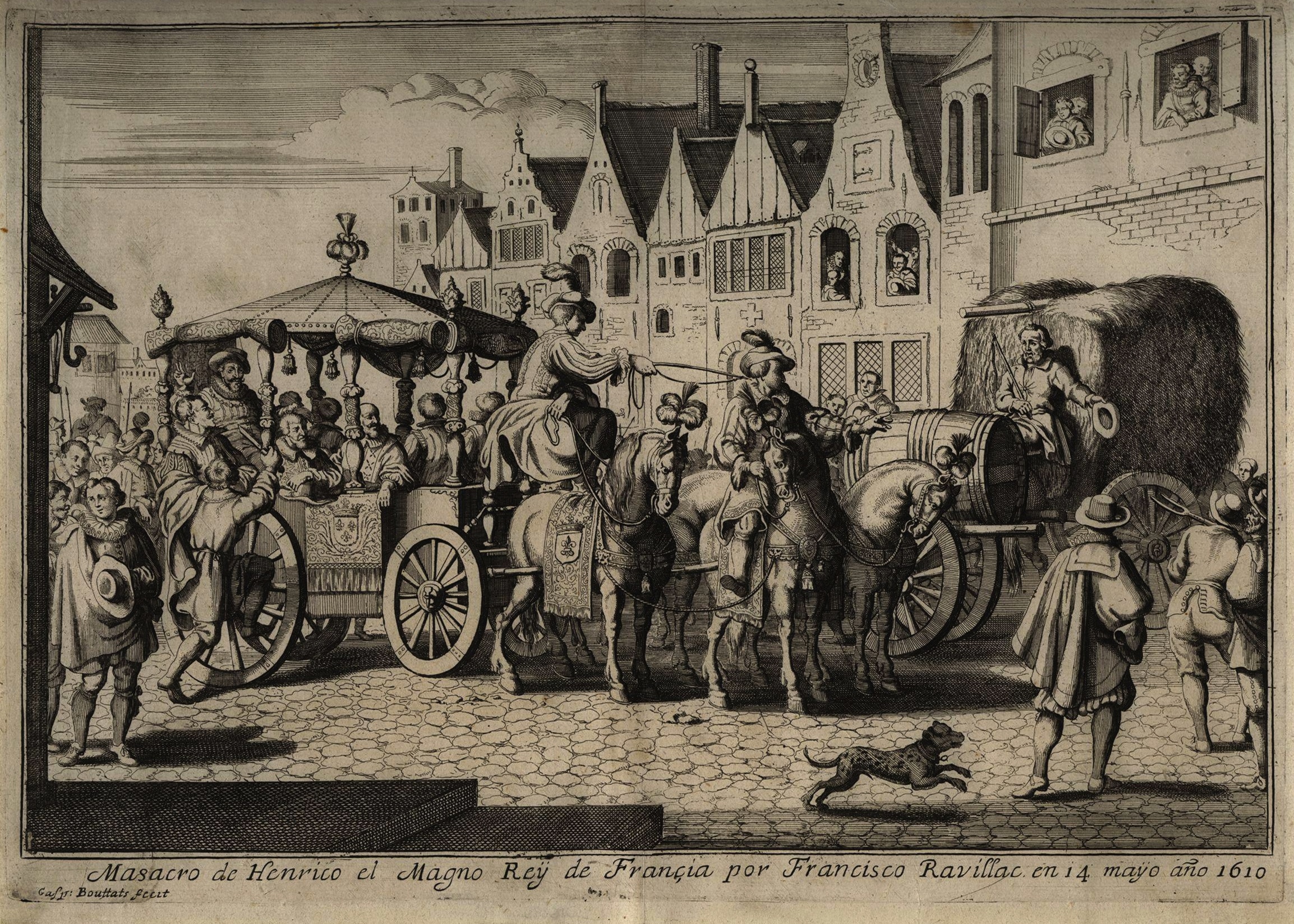
The best depiction I could find of a French early modern religiously-motivated assassination.  This one depicts the killing of King Henry IV in 1610 by the Catholic François Ravaillac.  Unfortunately, Belon was killed at night, however, and probably not in a royal party-coach. 


A Catholic and a royal favorite during the time of Reformation-era Wars of Religion, Pierre Belon was assassinated, probably by an Elect-loving Huguenot, in Paris one evening in April 1564, when coming through the Bois de Boulogne park ("Baloney Forest"), perhaps returning from a visit with a lady of the night. Unlike his fellow sixteenth-century compatriot King Henry IV (a Huguenot!), Belon was unable to escape the assassin's blade on the first attempt.*

Despite his sad end, Belon left posterity some great scientific work and some interesting illustrations, several of which I produce below.  Enjoy! 


"Turning and turning in the widening gyre, the falcon cannot hear the falconer": A Paul-Bunyan-sized gentleman falconer and his Roc-sized falcon, or perhaps the dog is an early example of the French craze for all things miniature? From The Nature of Birds.  


Possum-lizard?  From Observations.


Exotic fauna: Saracens (L) and Turks (R).  From Observations.


"Portrait of a Circassian nobleman, or Arabs on horseback, who were the riches lords of Egypt, when the Sultan [Saladin?] ruled there."  From Observations.


Some owls!  Belon observed that, while most owls liked to perch on tree limbs or stumps, that the French Barn Owl preferred to roost on a living rodent.  From The Nature of Birds.  


Human and Bird Skeletons Compar'd.  From The Nature of Birds.  


Ghost shadow parrot!  From The Nature of Birds.  


The strange marble-column roosting French variety of woodpecker.  From The Nature of Birds.


Ce ne sont pas unes pipes!  From Observations.


Here there be dragons.  From Observations.


Non-horned and Horned Snakes.  From Observations.


The Roman Emperor Hadrian, floating on the Tiber with his pet hippo, Antinous.  From Strange Fishes.


More hippo (walking on water)!  Eating an iguana?: "Removed from the statue of the Nile, of the garden of Belueder at the palace of the Pope in Rome." From Strange Fishes.


Sea serpent!  From Strange Fishes.


"Picture of the Order that the Latins called Orca or Orcynum."  From Strange Fishes.


The Arbalestre, or Crossbow (now called Hammerhead) Shark.  From Strange Fishes.


And, finally, a wing'd and be-scyth'd Satyr, patron saint of French anatomists. From Strange Fishes.


Well, Exalted Readers, I leave you now a little older, and perhaps a little wiser.  If nothing else, you've learned to never trust a strange Huguenot you meet on the road in the dark of night.  

Until next time, the Cabinet is closed.  

 ___________________________________________________________

*   "Henry IV finally was killed during the third attempt on his life, having fended off would-be assassins Pierre Barrière in 1593, later broken on the wheel, and Jean Châtel in 1594, who had his hand burned off with molten sulfur, lead and wax (a punishment for attempted regicide) and then was dismembered.  Ravaillac suffered the same molten hand-burning, but was drawn and quartered (like in Braveheart), which was perhaps not so different from dismemberment, in the end.  Bon temps!" 

- Extract from my forthcoming volume, Several Interesting Anecdotes of Attempted and Successful Royal and Political Assassinations, and their Subsequent Punishments, in Sixteenth- and Seventeenth-Century Europe, Together with a Treatise on the Art of Early Modern Regicide (self-published).  

28 April 2011

Lost without James Boswell


James Boswell at the tender age of twenty-five*.  It is not known widely that Boswell was a great Owl-Fancier, and, for many years, kept a parliament of them on the roof of his house in Covent Garden, London.


Reader(s), in past posts, I have made no secret of my great enthusiasm, daresay eighteenth-century-style Mania, for great English writer and wit-factory Dr. Samuel Johnson, author of the first acclaimed Dictionary in our language. (See my previous entry on the Quotable Doctor.) But, in my ungentlemanly submission to the Passions, I haven't given Johnson's biographer and close personal friend James Boswell his proper due.

Some critics, specifically the Victorian-era historian and critic (and fellow Scottish blowhard) Thomas Babington Macaulay, have attacked Boswell as, "Servile and impertinent, shallow and pedantic, a bigot and a sot, bloated with family pride, and eternally blustering about the dignity of a born gentleman, yet stooping to be a talebearer."  Furthermore, he was an "eavesdropper, a common butt [of jokes] in the taverns of London" who was "curious to know everybody who was talked about...vain of the most childish honors."  What others "would have hidden was matter of gay and clamorous exultation" to a man with such a "weak and diseased mind." 


The Ghost of Samuel Johnson appears to graphomaniacal biographer James Boswell, his arm extended in foreboding perpetual greeting to his frightened-looking "Retailer of Phrases."


Kind words from the 1st Baron Macaulay! Few, however, have such a low opinion of Boswell these days, and Macaulay's Lays of Ancient Rome goes unread**, while the Life of Johnson endures as a classic of English literature.  And Boswell, despite his predilection for pomposity and prostitutes, couldn't have been as bad as all that.  

If nothing else, I admire not only the young man's ability to will into being, through sheer doggedness, a friendship with the much older and much more famous Dr. Johnson, but stand in awe of the stamina and single-mindedness necessary to crank out over a thousand pages of reminiscence and anecdote on said acquaintance. Truly, with Mr. Boswell, we have a remarkable character, exemplary of the eighteenth-century self-fashioning man-about-town, not to mention one capable of great Epicureanism and womanizing!


The dearly-departed and armless Dr. Johnson (literally) looks down upon his biographers, his pseudo-mistress Hester Thrale, left; tricorn'd John Courtenay, center; and squinting "Bozzy" (Johnson's actual nickname for him), right.  (Thomas Cornell, 1790s)


Boswell was born in 1740 in Edinburgh, Scotland. Despite growing up among a race of incorrigible oat-eaters and English-corrupting Lairds, Boswell  made it to the metropolis of London by 1763. There, poised to while away his time in libertine debauchery, the twenty-two year-old had a chance meeting with fifty-four year-old Samuel Johnson at a bookshop that set him on the path to star wagon-hitching and literary immortality.***

During their first encounter, Johnson, upon learning of Boswell's origins, chastised him, to which Boswell responded, "I do indeed come from Scotland, but I cannot help it," to which the Bard of Lichfield replied, "That, Sir, I find, is what a great many of your Countrymen cannot help!"  


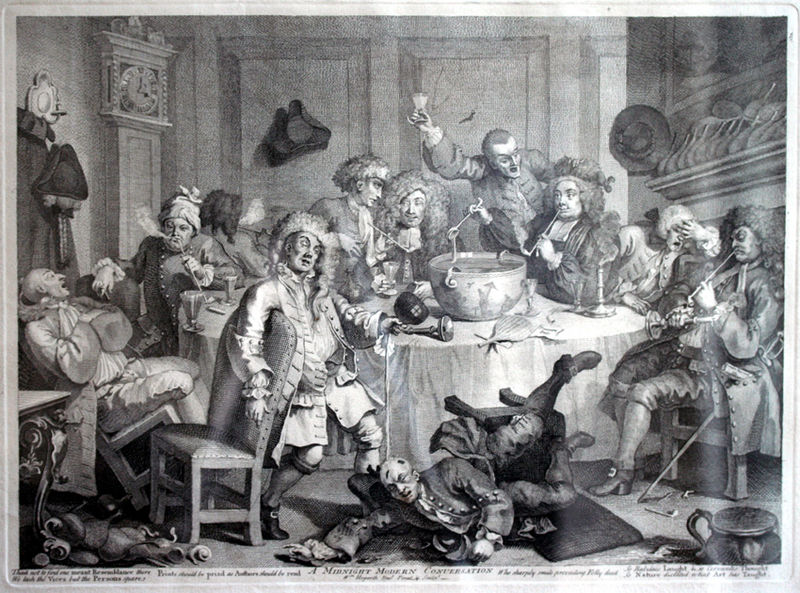
A gathering of "The Club."  Johnson is seated and alert, ladeling out more rum punch for his fellows (and strangely puffing on a pipe).  The wig-less man to the left of Johnson, with a glass raised and patting him on the head, is the hack writer Goldsmith, and the man dozed off with a horn in his hand is the portraitist Reynolds.  As usual, Boswell, lies, fallen out of his chair, in a stupor of his own creation, in the foreground.  (Engraving by William Hogarth, 1765)


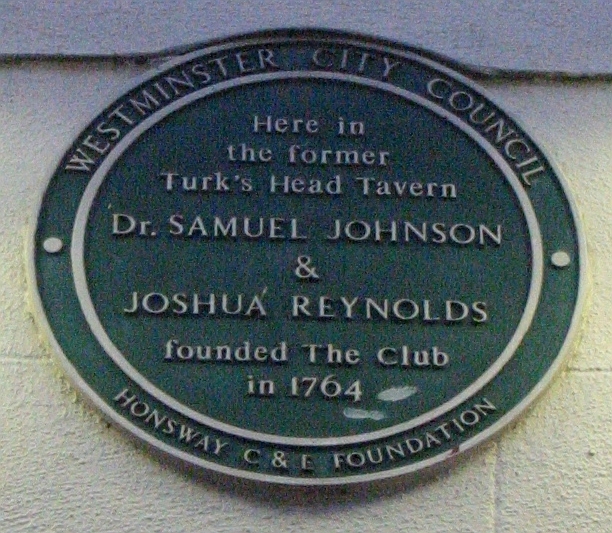
The two eventually became bosom friends, as Boswell insinuated himself into Johnson's inner circle of literary and artistic luminaries (The Club), despite the occasional aside from Sir Joshua Reynolds or Oliver "Stoops to Conquer" Goldsmith to the effect of, "Who the DEVIL is that young Scotch Blighter with the lousy [lice-infest'd] Periwig?" 

In 1773, the pair road-tripped, after much nagging by Boswell, to the exotic wilds of the Scottish Hebrides Islands. Boswell memorialized this moor and thistle-saturated holiday in his book A Journal of a Tour to the Hebrides with Samuel Johnson, LL.D, published in 1785.****  The memoir acted as (what the hive-mind of Wikipedia calls) a "teaser" for Boswell's forthcoming much longer treatment of Johnson's life.  


The first edition of Life of Johnson, printed "for Charles Dilly, in the Poultry" (not this).    


Boswell's biography was by no means the first published after Johnson's death -- seemingly everyone from his erstwhile and harshly-named confidant Hester Thrale to his beloved black Jamaican manservant and heir Francis Barber felt compelled to scribble down their impressions to make a guinea.  Boswell, though fond of a shilling as much as any man, began the great labor of composing his biography soon after Johnson's death but did not finish it until six years later. And what a "damn'd thick square book" it was, with the current Penguin Classics edition coming in north of 1,400 pages.  

Truth be told, Boswell's biography isn't much like most of its modern counterparts.  Much of the content consists of entire quoted letters and extensive entries from Boswell's diaries, stitched together by contextual narrative.  To be fair, Boswell also includes lengthy excerpts from Virgil and Horace from his Latin school books, most of the contents of his address book, and recipes for Rum Punch and Wassail. Yet, out of this muddle, Boswell succeeds in creating a variegated and inclusive portrait of not only Johnson, but of eighteenth-century literary culture. 

So what is the legacy of this Man of Letters, producer of perhaps the greatest biographical portrait existing in English?  Bigot and sot, or true friend and chronicler?*****  Pick up the weighty tome yourself, and decide for yourself!  Like the King James Bible, or the Adult Classifieds, it makes great random reading.  

Well, I retire to my drawing room anon, to read a little of the Life myself. I will aspire to imitate dear Boswell's work in form, if not length, in future posts.  Until next time, Courteous Readers, the Cabinet is clos'd.  


_____________________________________________________________


* Before stage four syphilis had set in.

** The film adaptation, though, proves to be enduringly popular at adult video stores.  

*** Don't worry, though.  Boswell still had ample opportunity for debauched vice, and capitalized upon it most splendidly!

**** Johnson had published his own much more generic account of the Scottish sojourn, A Journey to the Western Islands of Scotland (with some native Guy nam'd Boswell) eight years earlier, in 1775.  

***** Boy, they really need footnotes on Blogger.  Also, I recently discovered that Johnson and Boswell might have moonlighted as something akin to eighteenth-century amateur detectives (thief-takers, perhaps?), courtesy of Lilian De La Torre's engaging series of narrative biographies.  

30 March 2011

Baseball, the Great English Game


The National Pastime: A bat-and-ball game, called "baseball," but looking an awfully lot like cricket, from the 1767 book, A Little Pretty Pocket-book, essential for every young amateur sporting fellow.  

It's Spring in the Northern Hemisphere, and, in our fair United States of America, that means the return of the Grand Old Game, baseball! Opening Day of the Major League Baseball season is nigh, so, here at the Cabinet, we thought we'd take the opportunity to reflect on the amusing origin and peculiar history of that most "American" of sports.

It was Jane Austen, that great promoter of amateur sport, who wrote of one of her heroines in her 1799 novel Northanger Abbey
It was not very wonderful that Catherine who had by nature nothing heroic about her should prefer cricket, base ball, riding on horseback and running about the country at the age of fourteen to books.

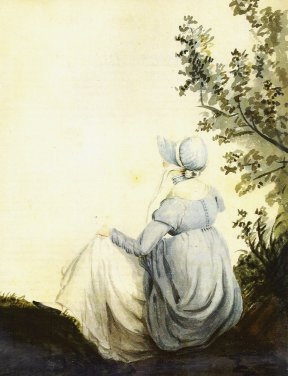
 An 1804 watercolor portrait by Cassandra Austen of her sister Jane engrossed in spectating a game of village cricket played near the family home in Bath.

As this rousing quote from the Queen of British Novelists shows, most now agree that baseball evolved from several English bat-and-ball games brought to America's shores by seventeenth- and eighteenth-century colonists.  But what of these peculiar pastimes, so foreign to Americans today yet embraced by Albion and much of its former empire?

Foremost among these ancestors of baseball is CRICKET, which originated as a children's game, perhaps related to BOWLS (lawn bowling), during the fifteenth and sixteenth centuries.  Beginning in the seventeenth century, however, adults, perhaps as a result of new-found, sheep-induced leisure time, took up the sport. The first reference to cricket being played by adults occurred exactly four hundred years ago, in 1611. Two men from the dragon-infested county of Sussex were brought to court for playing the game on a Sunday instead of attending church. Their fate is unknown.


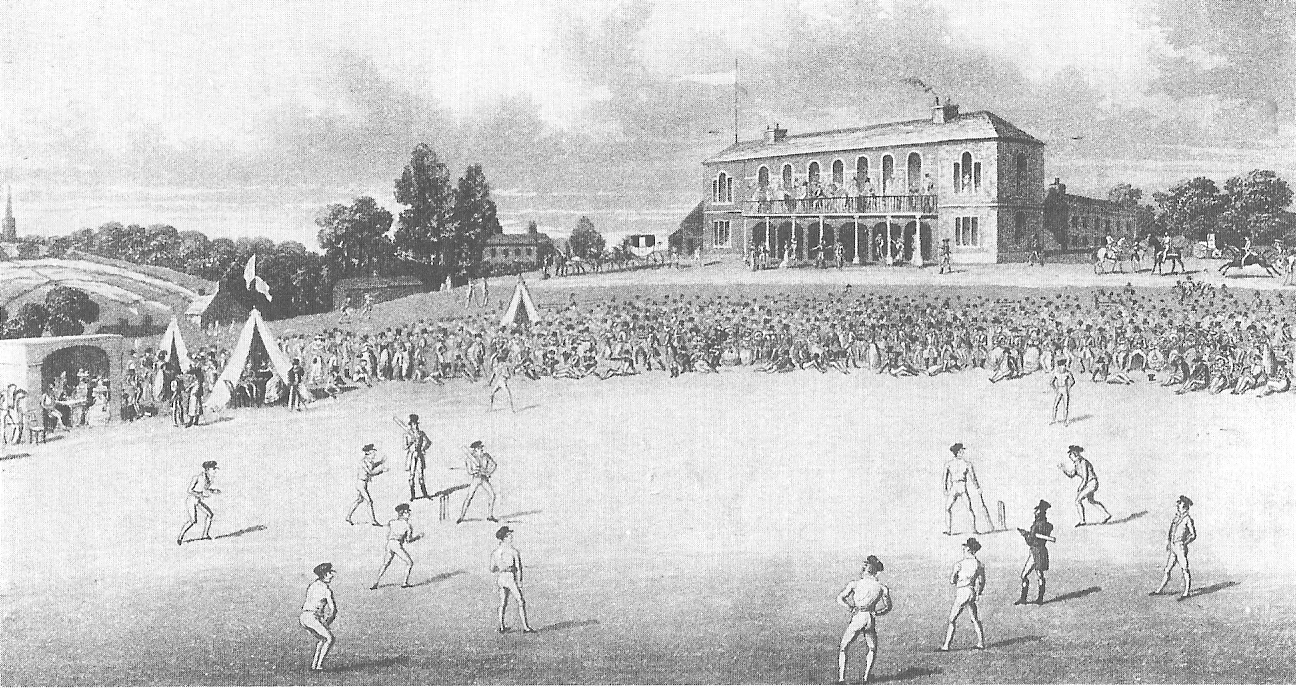
An illustration of a cricket ground at Darnall in Sheffield, England, from around 1820.  Not sure about those teepees in the crowd -- mark it up to the influence of George IV's oriental tastes, I guess. 

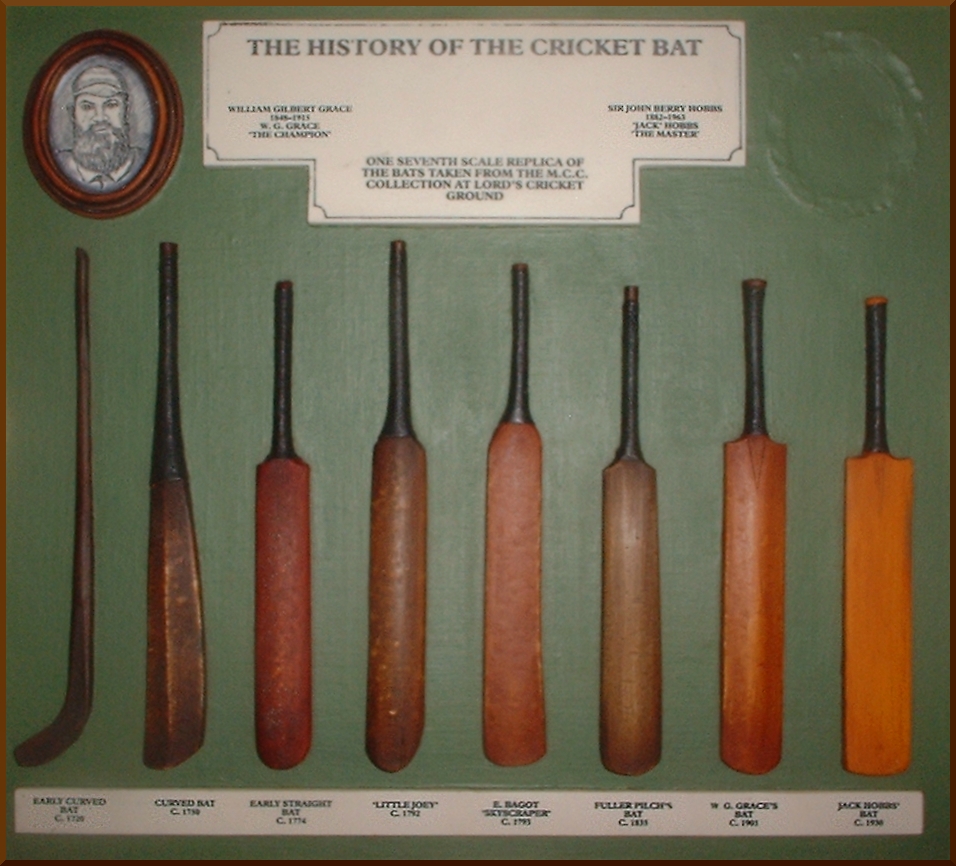
Originally, the bowler ("pitcher") rolled or skipped the ball toward the wicket ("home plate") in the hope of getting it past the batsman ("batter") and knocking down the bails perched atop the wicket stakes ("striking them out"). At first, the cricket bat ("bat") resembled something like a shepherd's crook, but, after the introduction of sidehand and then overhand throwing, it took on a straighter, more recognizable shape. (It is now perhaps most familiar to Americans as an ornamental torture device used in the collegiate Greek system). It remains popular among shepherds, however, who still champion a return to this older, more pastoral form of the game. I will not attempt here to explain all the intricate rules of cricket, nor will I try to define such vital concepts as the Googly, the Diamond Duck, the Chinese Cut, the Nervous Nineties, the Perfume Ball, and the Dibbly Dobbly, for these are sticky wickets indeed to the cricketing novice.  


Cricket Bats: The first two examples on the far left date from 1720 and 1750, respectively.  
(Courtesy Wikimedia Commons)

The game of cricket, of course, has a huge non-American worldwide following today, particularly in the former colonies of Britain's nineteenth-century empire, including the nations of the former British Raj, antipodean Australia and New Zealand, and troublesomely-Dutch-infested South Africa.  It has traditionally been a slower-paced, more genteel game than baseball, at least judging by all those tea and cucumber sandwich breaks and white sweaters, but a new, quicker game, more resembling baseball in its pacing, has been adopted eagerly by the huge community of Indian cricketers.


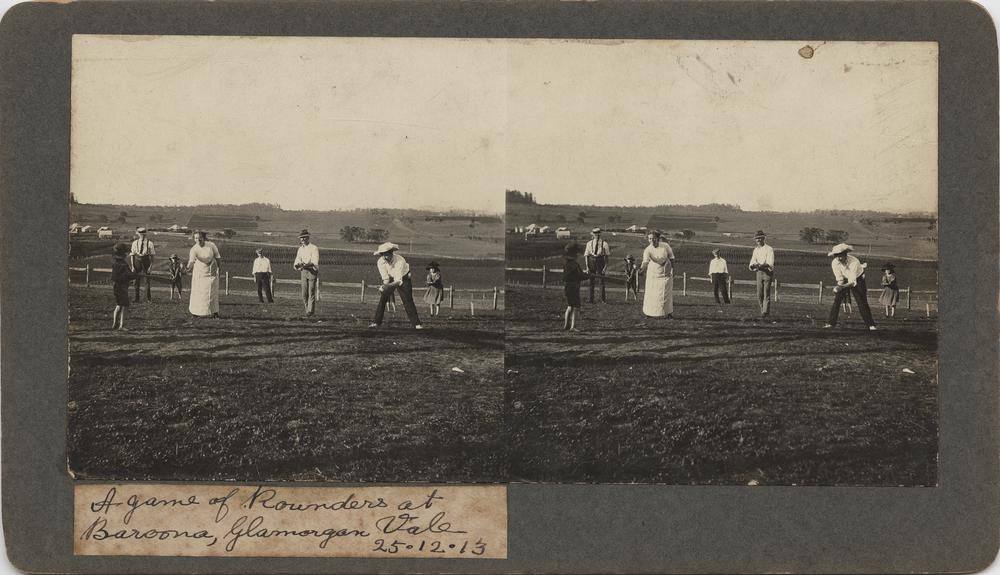
"A game of Yuletide Rounders at Baroona, Galmorgan Vale," Australia, played on Christmas Day, 1913. Note the player in the back dressed as Father Christmas.

But baseball is not solely a corruption of cricket. Another English bat-and-ball game, ROUNDERS, more closely resembles baseball in form and has been played in England since the sixteenth century. Like the American Game, it includes four bases, nine players to a side, and is organized into innings. Each side takes turns batting and fielding, and a player's successful run around the bases scores a run.  

As you might imagine, these similarities struck fear into the hearts of American baseball boosters at the turn of the twentieth century.  Many saw it as unpatriotic to admit that the most American of sports was merely a bastardized version of British games.  The most ardent champion of the native invention of baseball at was Albert Goodwill Spalding, he of the sporting goods company and magnate of the Chicago White Stockings (today the Cubs) of the National League.

A great debate over the game's ancestry ensued after British-born promoter of baseball Henry "Hanging Harry" Chadwick published a 1903 article tracing baseball's origin from the "good old game of rounders, you know." Spalding, patriotic American that he was, appointed a commission, which reputedly included Samuel "Mark Twain" Clemens and Theodore "Big Stick" Roosevelt, among others, to trace and evaluate the origins of baseball.  


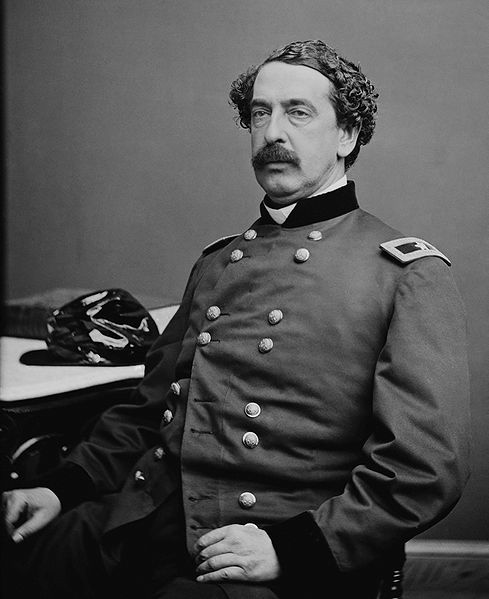
Pioneers of Baseball: Promoter and ball-designer Albert Goodwill Spalding (left), British inventor of the box score Henry Chadwick (center), and aloof Gen. Abner Doubleday (right). 

This "Mills Commission" unearthed a 71-year-old man from Denver, Abner Graves, who had witnessed the invention of baseball by Abner Doubleday, later a Civil War general, in 1839, while he was stationed in Cooperstown, New York. (A town best known as home to the author of the Redstocking Tales and High King of the Adirondacks James Fenimore Cooperstown.)  Luckily, Doubleday was long dead, and the commission did not attempt to corroborate the old man's tall tale, despite the fact that Doubleday had never even played baseball or even watched a game.

Spalding threw an elaborate and expensive dinner party to celebrate the findings, held at Delmonico's in Manhattan, featuring huge, baseball-shaped souffles and waiters serving with mitts. Committee head Abraham G. Mills, in his address to the audience, summed up the findings of the commission with the curious epigram "NO ROUNDERS. NO ROUNDERS." The unruly and sloshed crowd started chanting Mills' report with increasing urgency, until a melee ensued, during which, among other injuries to those gathered, Henry Chadwick lost his beard and Mills strained his groin. But the commission's findings were accepted as fact, and, in 1939, on the hundredth anniversary of baseball's supposed origin, the National Baseball Hall of Fame and Museum was opened in Cooperstown. 


A photograph of the dinner at Delmonico's celebrating the conclusion of the Mills Commission's investigation, pre-melee.  

Well, friends and readers, how can I top that story of ardent yet misguided patriotism? I therefore must now bring this edition of the Cabinet to a close.  I hope that, through the stories of the fine English games of cricket and rounders, you have learned something of the origins of our Great Game, be it American or no!
Related Posts Plugin for WordPress, Blogger...