Showing posts with label Frederick der Grosse. Show all posts

28 January 2011

The Russian Ben Franklin, Михаи́л Ломоно́сов


In addition to being a poet, astronomer, chemist, and general layabout, Lomonosov mastered the art of the no-look diary entry.  

Hello, Cabinet patrons! In this installment, I bring you the story of Mikhail Vasilyevich Lomonosov (1711-65), Russia's answer to Benjamin Franklin and Johann Wolfgang von Goethe -- father of Russian science and poetry and all-around Mensch.  

Lomonosov grew up on the shores of the White Sea on Russia's northwest coast, the son of a fisherman and descendant of the Pomor settlers in the region. No quick study at fishing, in 1730, at age nineteen, Lomonosov struck out for the big city, Moscow.  He was admitted to Russia's Harvard, the unfortunately-named Slavic Greek Latin Academy, completing a twelve-year (!) degree in five years.  Later, he was able to study chemistry and mining for two years in Germany at the University of Marburg.  There, Mikhail picked up the German language, picked up a German wife, Elisabeth Zilch, and picked up a svengali, the eminently-named philosopher, Christian Freiherr von Wolfius.  


Lomonosov's chemistry lab/breakfast nook.
(Northwestern Univ.)

Returning to Mother Russia in 1741, Lomonosov taught physicks and chemistry at the Russian Academy of Science, where he encouraged his students to call him "Doc Lommy" and "Teach." He inspired young mind at the RAS until 1755. (Except for a short interlude in 1743, during which he was house arrest for personally insulting several prominent faculty members!)  Lomonosov left the RAS to found the venerable Moscow State University (MSU), now also known as the Lomonosov Memorial Moscow State University.  


Sketches by Lomonosov of the Northern Lights. Reportedly, his students marveled at his chalkboarding expertise.
(Northwestern Univ.)

Lomonosov was a true polymath during a century of great Renaissance (well, not that Renaissance) men (and women).  Here's a sampling of some of his many interests and achievements:
  • An enthusiastic amateur astronomer, he hypothesized the existence of Venus' atmosphere, which prompted Czarina Elizabeth to christen the planet "New Siberia."
  • He made major improvements to the telescope, co-inventing what is now known as the reflecting or Herschelian telescope, a "window on the West," which, on imperial decree, he used to spy on the various palaces of the absolute monarchs of Europe.  
  • He published a catalog of over three thousand minerals in 1745, later a popular source for light readings  and entertainments at St. Petersburg's Paris-style salons.  
  • Lomonsov organized an expedition, helmed by Vasily Chichagov, to find the Northeast Passage sea route between the Atlantic and Pacific Oceans. Wisely, Lomonsov avoided actually going on this ice-hampered journey through the Frozen North.  
  • He was also a prolific mosaic artist! He set up a glass factory to produce the materials for his forty giant mosaics, most commemorating Great Moments for the Fatherland. 
  • A venerable writer, Lomonosov wrote a history of Russia, and reformed Russian poetic language, producing a reformed grammar combining vernacular Russian with Old Church Slavonic, an innovation he used to write several poetic works.  His "Ode to Carolus Linnaeus' New Genus-Species Classification System" was written for performance on his election into the Royal Swedish Academy of Sciences in 1761.  
  • He was also interested in icebergs, the properties of mercury, organic chemistry, bejeweled eggs, optics, continental drift, and wig design!
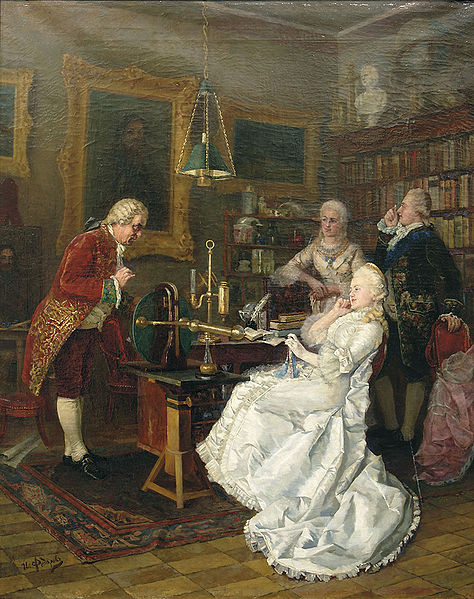

Russian empress (and amateur natural scientist and animal husbander) Catherine the Great visits Lomonosov in 1764.  (Ivan Fyodorov, 1884)

Lomonsov is still a big deal in Russia, seen as the man who brought the ideas of the Western European Enlightenment to darkest Russia.  He is to science what Puskin is to Russian literary culture or Rasputin is to well-endowed hemophilia-curing mystics. 

Let's have a trio of huzzahs! (or Ура's!) for Mikhail Lomonsov!  

21 December 2009

Hermits of Regency Britain


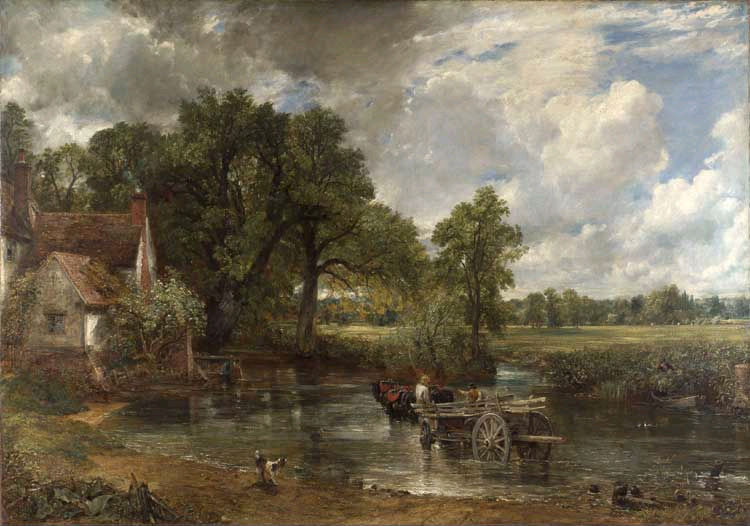
A nineteenth-century English idyll: Hermits and haywains.

Listen up, ladies -- I have a most interesting tale for your consideration! If you love the works of Jane Austen, with their romantic portrayal of the aristocracy of early nineteenth-century England, this post is for you.

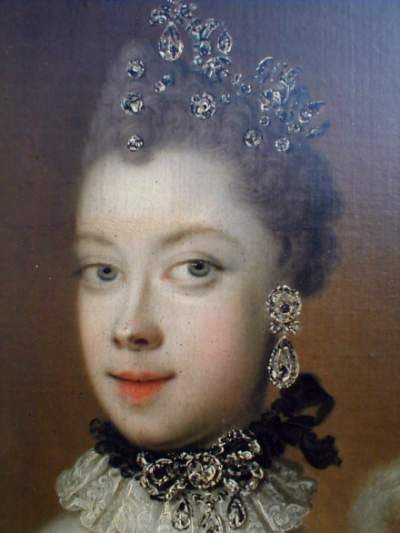
Once upon a time, there was a king of Britain named George III. Perhaps you know him. He was the man that perennial Cabinet favorite George Washington personally bested in a game of nine pins in the gardens of Versailles to gain the naming rights to forty-three-per-cent of the taverns, alehouses, wayside inns, public houses, and ordinaries in the American colonies. A master of wizardry, he used his comprehensive knowledge of spells to transmogrify famed Prussian monarch (and George's cousin) Friedrich der Große into an oak tree. He had never forgiven Fred, who, in a spell of religious zealotry, had struck George with a cane and spat in his wife Charlotte's (admittedly plain) face at a fete in 1788.


In addition to his regal duties, George served as headmaster of the newly-established Royal Academy of Witchcraft and Wizardry

George had a son, also named George, that fettered away his time instead of apprenticing to his father in the noble arts of magick, proving a große disappointment to just about everyone. Yet the Prince did excel in one thing: lavish hedonism! Also, he was mildly satisfactory at serving as Prince Regent for his father, a position he accepted after the House of Commons declared the King's spell-casting too out of control for a ruling sovereign, following a notorious incident where an annoyed George briefly turned William Wilburforce and Odullah Equiano into Cat-holics.


Contrary to popular opinion, dancing masters make poor hermits.


But what does this have to do with hermits, you might be asking? Did George III summon an army of his loyal servants, the hermits, to reclaim his lost crown from the Prince Regent, only to find that most hermits would rather live on a stone pillar in the baking heat of the desert rather than cooperate with their fellows? Although that would make for an exciting blog entry, and, in fact, almost did come to pass, I'm afraid that I made it up. But the Hanoverians and hermits are indeed connected, I assure you!

Let us return to that hedonistic fop, the Prince Regent George. His unfettered lifestyle inspired other romantic types to similarly indulge themselves and long to become syphilitic and/or consumptive. The broad cultural trend of a return to nature (probably not inspired by non-exercising George) inspired the golden age of the country estate, a fancy house owned by a rich family with a bunch of servants and lots of specialized rooms. With their excess moneys,
they made what they thought to be recreations of the pastoral landscapes found at ancient Roman country villas. And what scenic vista, they reasoned, could be truly pastoral without a solitary man of the soil to complement the landscape?


A latter-day hermit.  

In vain the great families of England tried to attract these grizzled loners to partake of the natural bounty that their estates offered. Many even had prefabricated hermit shacks or huts (see picture at right) installed on their lands in hopes that a roving gentleman might see them and take up residence. But the hermits, one of the first professions to unionize in the wake of the burgeoning Industrial Revolution that brought the Iron Rooster to their idyllic haunts, wanted in on the prosperity of their prospective landlords and demanded compensation. The landed gentry relented, ushering in the golden age of British hermitry.


Many of the great cultural achievements of the Regency period celebrate this renaissance of solitary living. Perhaps you remember the scene in Jane Austen's Mansfield Park when the heroin, Fanny, despairing because of Edmund's seeming involvement with Mary Crawford, runs away, only to become lost on the eponymous estate. She stumbles upon the cabin of Walter, Mansfield Park's resident hermit, and his comforting words result in a secret tryst whose vividly explicit details belong more in Austen's Harlequin series, Regency Nights. As with many of her writings, Jane based this episode on her real life experiences in rural Hampshire, during which she was romantically involved with a hermit, as profiled in a recent biopic. Many of the scenes in the film are speculative, but John Malcovich, who plays Walter, gives, in my opinion, a barbaric yawp of a performance.

But what did these ensconced misanthropes do with their time, and how did they interact with the family that resided on the estate? Why did these hermits seemingly "sell out" to "the man"? And what does all this have to do with the enclosure system? Only a return visit to the Cabinet, or an unnecessarily lengthy discussion with George III's portrait, will yield semi-satisfactory answers to these questions! Until next time, the Cabinet, like my mind, is closed.
Related Posts Plugin for WordPress, Blogger...