Showing posts with label 17th century. Show all posts

05 February 2013

Queen Anne's Lace: Or, A Natural History of the Wild Carrot


Her body is not so white as
anemony petals nor so smooth—nor
so remote a thing. It is a field
of the wild carrot taking
the field by force; the grass
does not raise above it.
Here is no question of whiteness,
white as can be, with a purple mole
at the center of each flower.
Each flower is a hand’s span
of her whiteness. Wherever
his hand has lain there is
a tiny purple blemish. Each part
is a blossom under his touch
to which the fibres of her being
stem one by one, each to its end,
until the whole field is a
white desire, empty, a single stem,
a cluster, flower by flower,
a pious wish to whiteness gone over—
or nothing.

- William Carlos Williams

Queen Anne's Lace: beautiful wildflower, as our greatest nominally-double-barreled poet would have it, or noxious weed, as the United States Department of Agriculture and legion disgruntled farmers contend? Only an overly-lengthy and digression-prone blog post by an Erudite Amateur Scholar can get to the bottom of this troublesome question.


Botanical print of Daucus carota (1885). 

Several plants are known by the name of QUEEN ANNE'S LACE (QAL), but it is the humble Daucus carota to which I refer. The plant also is known as: Wild Carrot; Bird's Nest; Devil's Plague; Bee's Nest; Rantipole; Lace Flower; and Bishop's Lace. Strangely, given the royal origin of the name, it is usually only called Queen Anne's lace in our fair anti-monarchical United States.  


QAL is a biennal, a plant that germinates, flourishes, and dies within two summers. This life cycle is far less common than that of the annual or perennial. During Year One, it puts out roots and leaves. After overwintering, it flowers and goes to seed during the second summer. Ah! Summer's lease hath all too short a date! 
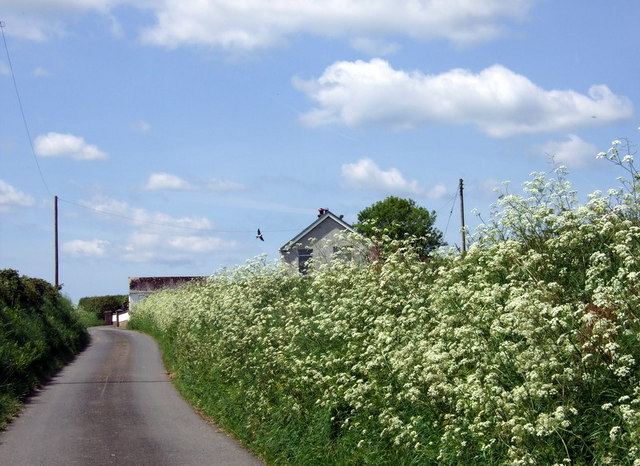


A small colony of Queen Anne's Lace in various stages of bloom

The flower stalk is nigh on a yard (one meter for my non-American and non-Liberian readers) high. The inflorescence, called an umbel, is made up of dozens to hundreds of tiny individual flowers. The flowers are white, with the common exception of a single wine- (or blood-!) colored flower in the center of the umbel, which is used to attract insects. 


Daucus carota is not to be confused with the "Philosopher's Bane," the POISON HEMLOCK (Conium maculatum), a biennial both pleasing to the eye and troublesome to the mammalian central nervous system. The two species have similar-looking leaves and flowers, but the expert naturalist can spot that the hemlock has smooth (not hairy) stems and often stands a full yard (1 m.) taller than QAL. But this doppelgangerality shouldn't be a problem unless you use it as a Clif Bar substitute during your nature walk. 


Botanical print of the poison hemlock (1897)

But is Queen Anne's Lace good for anything except lookin' perty? Perhaps! The first recorded mention of QAL comes to us from Ancient Greece, land of the Democracy and botanical corporal punishment. The great medical doctor and notorious oath-taker Hippocrates of Kos (c. 460-370 BCE) recommended the seeds as a contraceptive, probably on the advice of Mrs. Hippocrates.  


The great Greek physician Hippocrates, whose experiments with and exposure to the wild carrot resulted in premature baldness and a permanent pupil-less, thousand-bēma stare.


Man's fecundity: A sampling of varieties of "Eatin' Carrot" bred from the wild QAL.

Would you believe that QAL, the so-called wild carrot, is, in fact, the hearty natural stock from which our ingenious human ancestors selectively bred the familiar carrot sold by every greengrocer worth his or her greengroceries? Carrots were, at first, cultivated for their leaves, which were used for greens, and their aromatic seeds, which were used for smelling. The cultivated carrot we eat today is the taproot, which, when in its wild state, has a rather unpleasant woodiness, bitterness, and noticeable dearth of orangeness. 


Botanical print of the newly-orange carrot (1796)

It was those great orange-loving, botanical-novelty-demanding innovators, the Dutch, who gave the carrot its modern hue in the seventeenth century. This new brand of carrot was sweeter, and perhaps was a tribute to the Dutch royal family the House of Orange, famous for its scions William the Silent, first head of state assassinated with a firearm, and William III of Orange, King of England, first head of state assassinated by a mole.


William the Silent (1533-84), founder of the Dutch House of Orange, in the middle of being assassinated with a pistol, or dood peen.

But back to the carrot's unruly forebearer. Who is the royal namesake of Queen Anne's lace? It is said that this "Queen Anne" loved to make "lace," which resembles the white umbrel of the plant, but, because of her abnormally large, cumbersome hands, she often needle-pricked her finger, hence the single blood-red flower at the center. These are the main candidates:


Anne, Princess of Denmark (1574-1619), wife of James I/VI of England/Scotland (1566-1625, ruled 1567/1603-1625), and mother of Charles I, he of civil warring and regicide-inducing stubbornness. In addition her fondness for botany and lacemaking (notice her collar!), Queen Anne often went on long walks with her five identical dogs (not King Charles Spaniels, bred by her grandson, oddly) as her favorite horse and servant trailed behind at a respectable distance. (See above.)


Our second candidate is Queen Anne of Great Britain (1665-1714, ruled 1702-1714), great-granddaughter of the previous Anne and last of the Stuart line (and sister-in-law of William III of Orange!) to sit on the British throne. When not stuffing her face with carrots, Anne was busy birthing sickly and ill-fated infants, arguing with her best gal-pal Sarah Churchill, Duchess of Marlborough (and ancestress of Winston), and perhaps making lace out of flowers. 


No, not THAT Queen Anne's lace!

Your Humble Author is leaning toward Anne of Denmark as the true namesake, but, since it's all in the family anyway, I suppose the truth isn't so important. 

Well, Dearest Readers, another Cabinet post is drawing to a close, much like the curled-up, birds-nest-like seedhead of Daucus carota. I hope you have come to appreciate the carrot's wild ancestor, majestic biennial and favorite of roadside ditches everywhere. 

17 February 2012

"Three Years Travels from Moscow Over-Land to China": A 17th-Century Backpacker's Tale


Original title page in English, with a slightly modified title, and a veritable Oriental menagerie -- monkey (top right), elephant (bottom right), dead fish included (bottom-center).


In this installment, I have for your reading pleasure the tale of Evert Ysbrants Ides, seventeenth-century ambassador and traveler to deepest Orient. Such land journeys to Eastern realms were rare, and this early modern Paul Theroux was one of the few Western Europeans to visit Siberia or China before the late nineteenth century. Ides' account of the journey he made from Moscow to Peking (Beijing) in 1693 was published in English in 1705 as: 
Three Years Travels from Moscow Over-Land to China, thro' Great Ustiga, Siriana, Permia, Siberia, Daour, Great Tartary, etc. to Peking, Containing, An exact and particular Description of the Extent and Limit of those Countries, and the Customs of the Barbarous Inhabitants; with reference to their Religion, Government, Marriages, daily Imployments, Habits, Habitations, Diet, Death, Funerals, etc.
Well, that just about covers everything - imployments, diet, and death! Written by "his Excellency E. Ysbrants Ides, Ambassador from the Czar of Muscovy to the Emperor of China," it was first printed in Dutch "by the Direction of Burgomaster Witzen*, formerly Ambassador in England," being "now Faithfully done into English." (One assumes that the arbitrary use of italics was carried over from the original.) 


Nicolaes Witsen, stern patron of Ides and several Amsterdam wig-wrights.


Your Faithful Author can find little biographical information about Ides, but this lack of source material is rarely a problem here at the Cabinet.  His companion on the embassy to China, Adam Brand (also known as "Adam Brand, P.I." and "Adam Brand, Attorney at Law"), an Englishman, beat Ides to the punch, publishing A Journal of an Embassy from Their Majesties John and Peter Alexowits, Emperors of Muscovy, etc. into China...With some Curious Observations Concerning the Products of Russia.† But Ides' account has awesome illustrations (reproduced below)! 


Coincidentally, in 1697, the young Russian czar Peter "Alexowits" "The Great," the very man who had sent the embassy to China, made a similar envoy from Rus to the wild Occident lands of France, the Netherlands, and England. Peter traveled to Western Europe incognito, disguised as a poor eight-feet-tall journeyman shipwright, with a large posse of "apprentices" (royal hangers-on) in tow. 


"Pete Romanov" in his shipwright togs, with the ship he built with his own hands to sail back to Russia, loved a good embassy.


Witsen's 1705 map of Tartary. The Korea peninsula is on the bottom-right; the Chinese Empire at the very bottom; and the Bering Sea on the top-right. The realm of Prester John is mysteriously absent.  


Below are several illustrations from Ides' book - enjoy, Readers!


The daily commute: "Russians travelling with Dog sleads in Siberia"


"Samojedian Hart sleds": Why use dogs when you can use harts (reindeer, in this case), and wear woodwose-like fur suits? (Also, this reminds me of a Currier and Ives print!)


Is it just Your Humble Author, or does this look unmistakably like similar depictions of American Indians from the same period, tepees, buckskins, and bows and arrows included? Eerily Atlantean similarity across continents, or lazy John White-plagiarist


"The Embassadors entry through the famous Chinese wall which is 1200 miles long.": Ides relates how Dutch legends of his day told of how the Great Wall of Cathay was so extensive and, well...great, that even the dearly departed Elect could see it from the strict Calvinist Paradise upon high.  


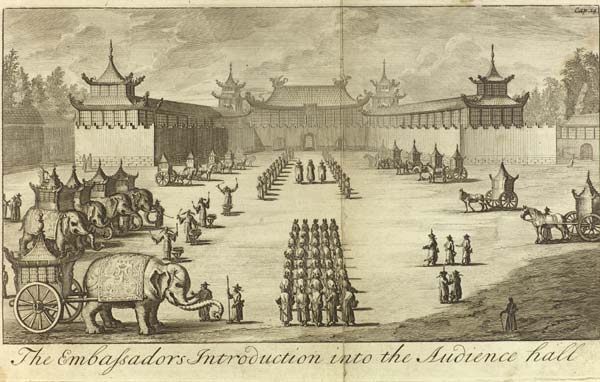
"The Embassadors Introduction into the Audience hall": The Imperial Court in Peking put Ides and his companions up in special mobile "elephant hostels" (on left) for the duration of their visit.   


"The Embassador entertained by the Emperor in the best audience chamber.": An honor for Ides and co., as most Europeans were relegated to the third-best audience chamber, especially Jesuits
_________________________________________________________________________________

 *    "Burgomaster" Nicolaes Witsen (1641-1717), thirteen-time mayor of Amsterdam, was a fellow Siberian explorer, whose book Noord en Oost Tartarye (North and East Tartary) also appeared in 1692 (1705 in English). This book, unlike Ides' travel narrative, is an encyclopedic account of everything Europeans knew (and made up) about Russia, Siberia, China, and Japan at the time. 


†   Sadly, Adam Brand's "Curious Observations" are doomed to disappoint the modern reader, although there is an extensive and fascinating section on the construction and distribution of ushankas (stereotypical Russian hats), several basic borscht recipes, and helpful tips on Old Believer beard maintenance.  

04 March 2011

Doctor Lambe, the Duke's Devil


"[Doctor] Lambe Stinkes worse than Mackerall or Haddocke," 
wrote one master of Jacobean light verse.  

I present to satisfy your curiosity, dear readers, the tale of the seventeenth-century astrologer-magician-physician John Lambe, a self-styled "Doctor" who numbered among his clients the most powerful man in England, George Villiers, 1st Duke of Buckingham, favorite of Stuart kings James I and Charles I.  

Born around 1545, little is known of Lambe's life before he came to London to ply his trade as conjurer-at-large.  He seems to have been a tutor to gentlemen's sons in Worcestershire, afterwards studying medicine.  But, as young medical students are wont to do, Lambe soon fell prey to "other mysteries, as telling of fortunes, helping of divers to lost goods, shewing to young people the faces of their husbands or wives that should be in a crystal glass."

Lambe was arrested in 1608 in Worcestershire for practicing his new profession, charged with disabling the physical and mental strength of and "generalley givving bad Vybes" to Thomas, Lord Windsor, and accused of invoking and entertaining "certain evil and impious spirits."  While being held, he proved to several visitors that he could cause apparitions to proceed from his crystal ball. He also prophesied death with fatal success, with some forty people that had been present in court dying within two weeks of the trial (probably just an outbreak of gaol fever, now called typhus :( ).  

Worcesterites successfully, and understandably, lobbied for Lambe's transfer to London's King's Bench prison, where he lived there in easy confinement, occupying two rooms, employing servants, and practicing "medicine" as before.  Indeed, in his heyday as a physician in London, Lambe claimed he could conjure spirits, find missing items with his crystal ball, treat maladies, exorcise witchcraft, and "do dirtey Deedes" cheaply.  

One of his client-visitors at the prison was Buckingham, always on the lookout for an easy anecdote when his fortunes waned at the Royal court. On June 12, 1626, London was hit by an unexpected storm, after which a mist hung over the River Thames near York House, Buckingham's residence. The superstitious, and Buckingham-haters, discerned ominous shapes in the fog, including a skull, a horse, and a giant lace collar. Lambe had appeared on the river earlier in the day, and many attributed these fearful meteorological disturbances to his conjuring. Buckingham's mother, though to be practitioner of the "cunning arts" herself, said she saw in Lambe's crystal ball the shadowy figure of a large man holding a dagger, poised to kill her son.  Needless to say, things didn't look good for either of our boys.  


John Lambe's patron, the Duke of Buckingham, who reputedly had his astrologer summon angels, naked children, and Greek sea gods for his enjoyment.  

Because of his perceived control of Buckingham, Lambe was slandered widely, in alehouses and in print. Broadsheets of the day called him things like the "Foole Lambe, that lewde Impostar," and Lambe was known widely as "the Duke's Devil."  A popular chant (and lullaby) went thus: "Who rules the Kingdom? The King. Who rules the King? The Duke. Who rules the Duke? The Devil!"

Public opinion against Lambe and the Duke became so negative that, by 1628, the octogenarian feared for his life.  Curiously enough, Lambe began his last evening, Friday the 13th (!) of June, attending an entertainment at an open-air theater called the Fortune (!) playhouse. There, he noticed a gang of "never-do-weles" and young punks making threats on his life and giving him the stink-eye.  The angry crowd followed him to dinner at a tavern, despite the sailor-bodyguards he had hired for the evening. He ducked into the Windmill Tavern, then hid a friend's house nearby. His naysayers surrounded both hideouts, demanding with thrown stones that Lambe be released to them. Eventually, kicked out onto the street, the crowd had their way with the old conjurer, assaulting him with stones and beating him with cudgels until no part of his body "was left to receive a wound," according to one witness.  Lambe was carried to the nearby Counter prison, where, despite desperate attempts at magical intervention, he died the next morning.  

Constables failed to locate any of the murderous mob, and no one was ever punished for Lambe's death. Many alleged this slight of justice, and law enforcement's failure to prevent the crowd setting upon the hated physician, was intentional. London mobs chanted, "Let [King] Charles and George [the Duke] do what they can, the Duke shall die like Doctor Lambe!" Lambe's patron was assassinated less than two months later by one of his former officers while dining in a Bristol tavern on the eve of his military expedition to France.  


A woodcut from the front of the broadside ballad The Tragedy of Doctor Lambe (1628). I'm guessing that's an evil demon, incubus, spirit, succubus, or the like conjured by Lambe on the lower-right.  


From the back of the same.  Apparently, Lambe was a Catholic monk who liked hiding under tables.

Crowds came (and paid) to see Lambe's body at the Counter prison. It was reported that Lambe had a strange assortment of items on his person when he died, as befitting an astrologer-physician. These everyday needs included a sword, knives, a crystal ball, a gold nightcap, twelve silk pouches, forty shillings, and eight small engraved portraits, including that of the Countess of Somerset, a favorite at court, an alleged witch and pardoned murderess.  


England was flooded with printed satiric commemorations, anti-tributes, and scandal-rags in prose and verse after Lambe's murder, remaining as popular a topic for discussion in death as he was in life. One balladeer, in The Tragedy of Doctor Lambe (1628), wrote of Lambe's death:

"Neighbours cease to moan,
And leave your lamentation,
For Doctor Lambe is gone,
The Devil of our Nation."

Another eulogized, in An Epitaph on Dr Lambe:

"Here Dr Lambe, the conjurer lyes,
Against his will untimely dies.
The Divell did show himselfe a Glutton
In taking this Lambe before he was mutton."

*     *     *
So, readers fair, here endeth our tale of the notorious life and ignominious death of Doctor John Lambe, infamous conjurer, passable early modern physician, and the face that launched a thousand hackneyed broadsides.  Until next time, the Cabinet is closed!  
Related Posts Plugin for WordPress, Blogger...