30 March 2011

Baseball, the Great English Game


The National Pastime: A bat-and-ball game, called "baseball," but looking an awfully lot like cricket, from the 1767 book, A Little Pretty Pocket-book, essential for every young amateur sporting fellow.  

It's Spring in the Northern Hemisphere, and, in our fair United States of America, that means the return of the Grand Old Game, baseball! Opening Day of the Major League Baseball season is nigh, so, here at the Cabinet, we thought we'd take the opportunity to reflect on the amusing origin and peculiar history of that most "American" of sports.

It was Jane Austen, that great promoter of amateur sport, who wrote of one of her heroines in her 1799 novel Northanger Abbey: 
It was not very wonderful that Catherine who had by nature nothing heroic about her should prefer cricket, base ball, riding on horseback and running about the country at the age of fourteen to books.
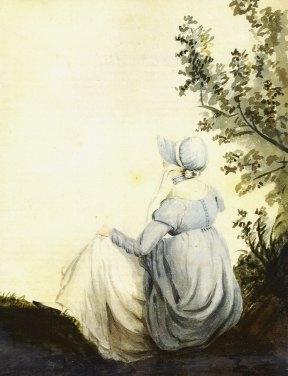
 An 1804 watercolor portrait by Cassandra Austen of her sister Jane engrossed in spectating a game of village cricket played near the family home in Bath.

As this rousing quote from the Queen of British Novelists shows, most now agree that baseball evolved from several English bat-and-ball games brought to America's shores by seventeenth- and eighteenth-century colonists.  But what of these peculiar pastimes, so foreign to Americans today yet embraced by Albion and much of its former empire?

Foremost among these ancestors of baseball is CRICKET, which originated as a children's game, perhaps related to BOWLS (lawn bowling), during the fifteenth and sixteenth centuries.  Beginning in the seventeenth century, however, adults, perhaps as a result of new-found, sheep-induced leisure time, took up the sport. The first reference to cricket being played by adults occurred exactly four hundred years ago, in 1611. Two men from the dragon-infested county of Sussex were brought to court for playing the game on a Sunday instead of attending church. Their fate is unknown.
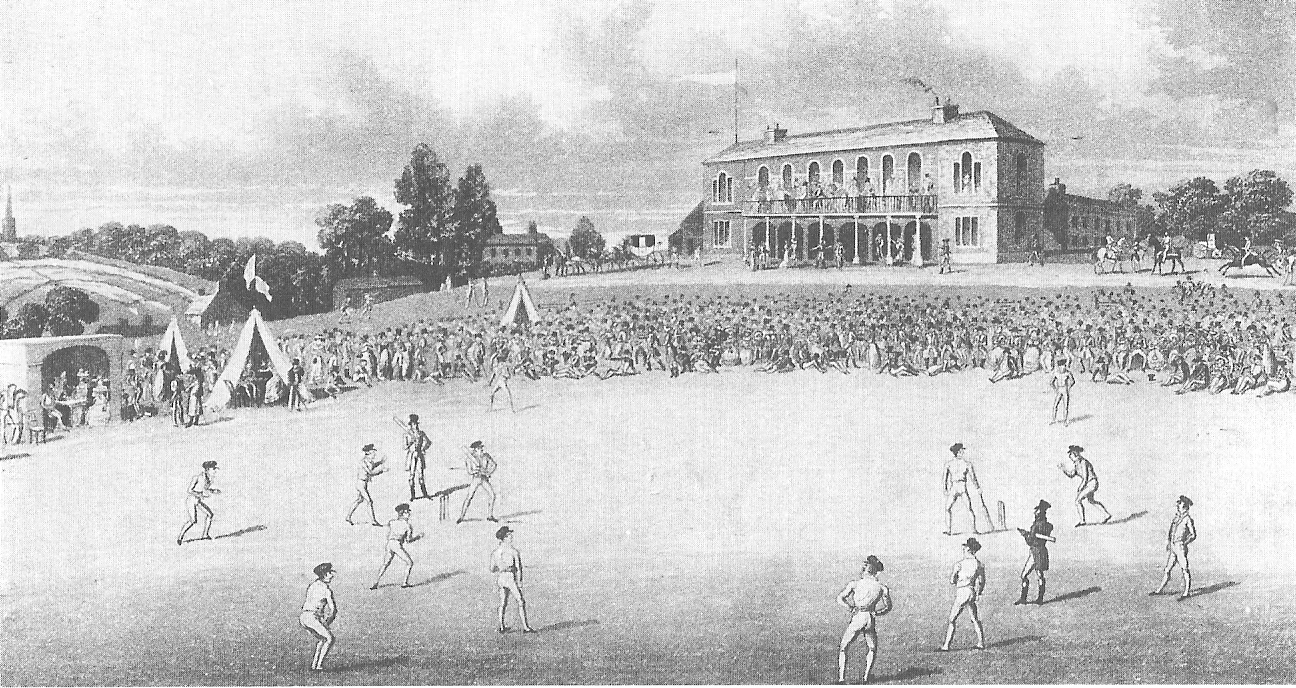

An illustration of a cricket ground at Darnall in Sheffield, England, from around 1820.  Not sure about those teepees in the crowd -- mark it up to the influence of George IV's oriental tastes, I guess. 

Originally, the bowler ("pitcher") rolled or skipped the ball toward the wicket ("home plate") in the hope of getting it past the batsman ("batter") and knocking down the bails perched atop the wicket stakes ("striking them out"). At first, the cricket bat ("bat") resembled something like a shepherd's crook, but, after the introduction of sidehand and then overhand throwing, it took on a straighter, more recognizable shape. (It is now perhaps most familiar to Americans as an ornamental torture device used in the collegiate Greek system). It remains popular among shepherds, however, who still champion a return to this older, more pastoral form of the game. I will not attempt here to explain all the intricate rules of cricket, nor will I try to define such vital concepts as the Googly, the Diamond Duck, the Chinese Cut, the Nervous Nineties, the Perfume Ball, and the Dibbly Dobbly, for these are sticky wickets indeed to the cricketing novice.  
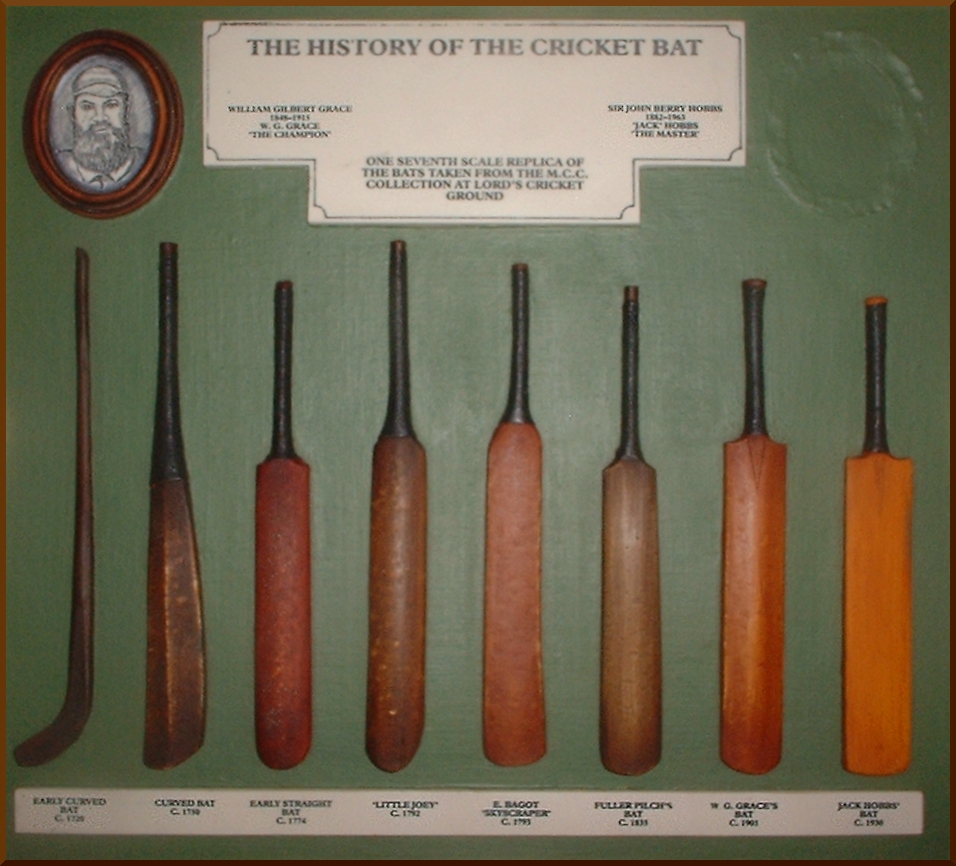

Cricket Bats: The first two examples on the far left date from 1720 and 1750, respectively.  
(Courtesy Wikimedia Commons)
The game of cricket, of course, has a huge non-American worldwide following today, particularly in the former colonies of Britain's nineteenth-century empire, including the nations of the former British Raj, antipodean Australia and New Zealand, and troublesomely-Dutch-infested South Africa.  It has traditionally been a slower-paced, more genteel game than baseball, at least judging by all those tea and cucumber sandwich breaks and white sweaters, but a new, quicker game, more resembling baseball in its pacing, has been adopted eagerly by the huge community of Indian cricketers.


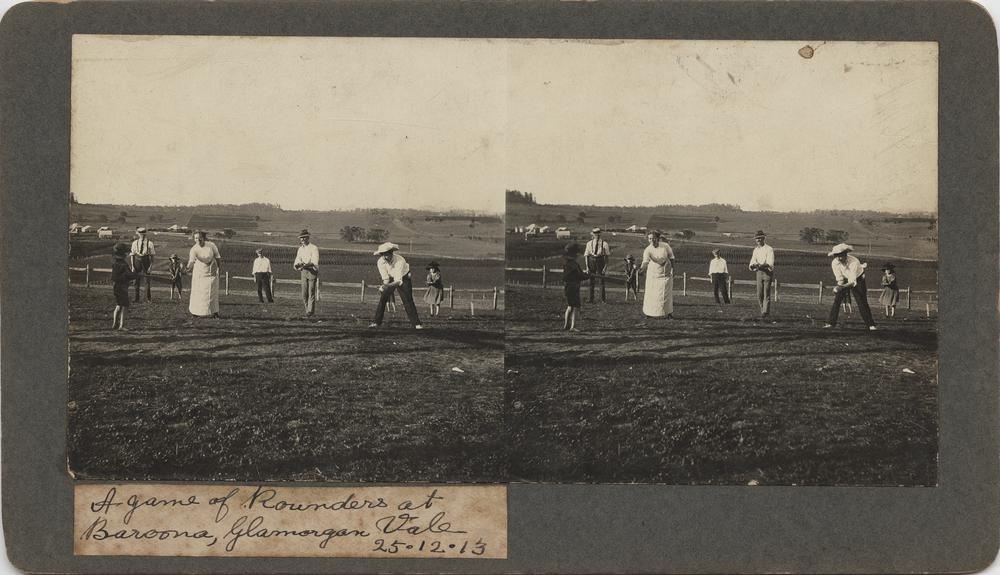
"A game of Yuletide Rounders at Baroona, Galmorgan Vale," Australia, played on Christmas Day, 1913. Note the player in the back dressed as Father Christmas.

But baseball is not solely a corruption of cricket. Another English bat-and-ball game, ROUNDERS, more closely resembles baseball in form and has been played in England since the sixteenth century. Like the American Game, it includes four bases, nine players to a side, and is organized into innings. Each side takes turns batting and fielding, and a player's successful run around the bases scores a run.  

As you might imagine, these similarities struck fear into the hearts of American baseball boosters at the turn of the twentieth century.  Many saw it as unpatriotic to admit that the most American of sports was merely a bastardized version of British games.  The most ardent champion of the native invention of baseball at was Albert Goodwill Spalding, he of the sporting goods company and magnate of the Chicago White Stockings (today the Cubs) of the National League.

A great debate over the game's ancestry ensued after British-born promoter of baseball Henry "Hanging Harry" Chadwick published a 1903 article tracing baseball's origin from the "good old game of rounders, you know." Spalding, patriotic American that he was, appointed a commission, which reputedly included Samuel "Mark Twain" Clemens and Theodore "Big Stick" Roosevelt, among others, to trace and evaluate the origins of baseball.  


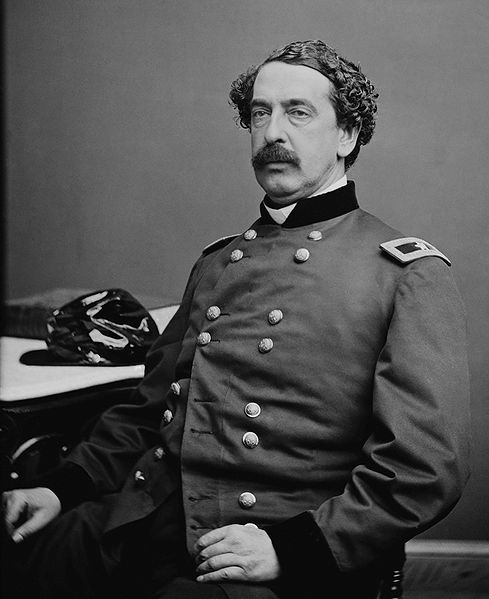
Pioneers of Baseball: Promoter and ball-designer Albert Goodwill Spalding (left), British inventor of the box score Henry Chadwick (center), and aloof Gen. Abner Doubleday (right). 

This "Mills Commission" unearthed a 71-year-old man from Denver, Abner Graves, who had witnessed the invention of baseball by Abner Doubleday, later a Civil War general, in 1839, while he was stationed in Cooperstown, New York. (A town best known as home to the author of the Redstocking Tales and High King of the Adirondacks James Fenimore Cooperstown.)  Luckily, Doubleday was long dead, and the commission did not attempt to corroborate the old man's tall tale, despite the fact that Doubleday had never even played baseball or even watched a game.

Spalding threw an elaborate and expensive dinner party to celebrate the findings, held at Delmonico's in Manhattan, featuring huge, baseball-shaped souffles and waiters serving with mitts. Committee head Abraham G. Mills, in his address to the audience, summed up the findings of the commission with the curious epigram "NO ROUNDERS. NO ROUNDERS." The unruly and sloshed crowd started chanting Mills' report with increasing urgency, until a melee ensued, during which, among other injuries to those gathered, Henry Chadwick lost his beard and Mills strained his groin. But the commission's findings were accepted as fact, and, in 1939, on the hundredth anniversary of baseball's supposed origin, the National Baseball Hall of Fame and Museum was opened in Cooperstown. 


A photograph of the dinner at Delmonico's celebrating the conclusion of the Mills Commission's investigation, pre-melee.  

Well, friends and readers, how can I top that story of ardent yet misguided patriotism? I therefore must now bring this edition of the Cabinet to a close.  I hope that, through the stories of the fine English games of cricket and rounders, you have learned something of the origins of our Great Game, be it American or no!

23 March 2011

The Ballad of Giles Corey: Salem's Stubborn Wretch


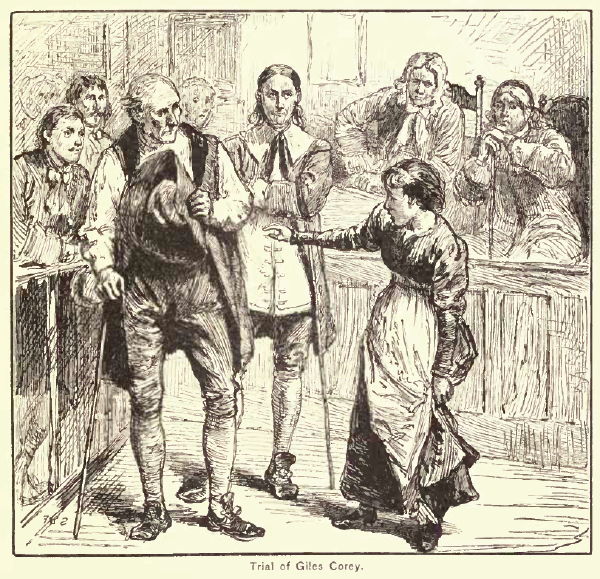
Trial of Giles Corey, an engraving by C.S. Reinhardt from noted old windbag and thanatopsistic William Cullen Bryant's A Popular History of the United States, 1878.

*   *   * 

Giles Corey was a wizard strong, a stubborn wretch was he;
And fit was he to hang on high upon the locust tree.
So, when before the Magistrates for trial he did come,
He would no true confession make, but was completely dumb.

"Giles Corey," said the Magistrate, "What hast thou here to plead
To those who now accuse thy sould of crime and horrid deed?"
Giles Corey he said not a word, no single word spoke he.
"Giles Corey," said the Magistrate, "We'll press it out of thee."

They got them then a heavy beam, then laid it on his breast;
They loaded it with heavy stones, and hard upon him pressed.
"More weight," now said this wretched man.  "More weight!" again he cried;
And he did no confession make, but wickedly he died.

*   *   *

This anonymous early eighteenth-century ballad concerns Giles Corey (1611-92), a victim of the infamous Salem witch trials of 1692-3. While most convicted Salemites were hanged, octogenarian Corey has the special distinction (privilege?) of being the only one punished by being pressed to death.  


Ann Putnam, "Have No" Mercy Lewis, and Abigail Williams accused Corey of witchcraft in April 1692. Putnam alleged that the specter of Corey visited her and asked her to write in the Devil's Book (coincidentally some of your Humble Author's favorite bedtime reading). She later claimed that a spirit who'd been "murthered most foul" by Corey also appeared to her. It would seem that the "dread Wizard" Corey's hologramic avatar had gotten around, because other girls subsequently relayed tales of similar spectral pestering that confirmed Putnam's accusations.  Fellow supposed practitioner of witchcraft Abigail "Leviathan" Hobbes confessed in court that Corey was a warlock on April 19. Stubborn old Giles, though, refused to enter a guilty or not guilty plea, and was gaoled for several months. 


Giles Corey's Punishment and Awful Death, from Henrietta Kimball's Witchcraft Illustrated, 1892. (I'm trying to resurrect the publication of this magazine, if you'd like to contribute.)


When the court sat again in September, Corey again remained mute.  So, the Oyer and Terminer brought out the big guns: pressing, the prescribed punishment for refusing to plea.  This piene forte et dure ("hard and forceful punishment"), not to be confused with the later piano forte, called for the prisoner to be stripped of their clothes and made to lie on the ground.  Heavy boards were laid over them, and rocks were piled on the wooden planks, increasing in weight until the prisoner confessed.  The Massachusetts Bay Colony legal code called for the prisoner "to be laid on his back on the bare floor, naked, unless when decency forbids; that there be placed upon his body as great a weight as he could bear."  He must "hath no sustenance, save only on the first day, three morsels of the worst bread, and the second day three droughts of standing water, that should be alternately his daily diet till he died, or, till he answered."* 


During the course of two days, so the story goes, Corey was asked three times to plead innocent or guilty to witchcraft. Each time he replied, "MORE WEIGHT!" and a new load of New England's famous soul-crushing fieldstone was added to the growing cairn.  Finally, at "about noon...Corey was pressed to death for standing mute; much pains was used with him two days, one after another...but all in vain."** Because Corey did not plea, he died with full possession of his estate.  Some have written this motivated Corey to stay silent, because the convicted had to forfeit their property to the colony, but the reality such a law has been discounted. In any case, perhaps Corey's endurance was not solely the result of an iron will, but was the action of a father looking after the security of his progeny, and an iron rib cage.  


Henry Wadsworth "Old Firesides" Longfellow, nineteenth-century celebrator and hagiographer of Corey and other obscure colonial worthies.


Giles Corey's story had a surprisingly enduring afterlife.  The sentimental old fool/poet Henry Wadsworth Longfellow wrote a play, one of his New England Tragedies, Giles Corey of the Salem Farms, about the stubborn Salemite. Longfellow's Corey justifies his actions to his bosom-pal Richard Gardner, saying: 
I will not plead. If I deny, I am condemned already, in courts where ghosts appear as witnesses, and swear men's lives away. If I confess, then I confess to a lie, to buy a life which is not a life, but only death in life. I will not bear false witness against any, not even against myself, whom I count least.
Compelling stuff in the old nineteenth-century melodramatic tradition, I say!  As Corey dies, Longfellow puts these words in his mouth: "Here is my body; ye may torture it, but the immortal soul ye cannot crush!"  Although an unexpected burst of King-James-style eloquence from a man being pressed to death, it is, I think, a fitting and inspired pun, courtesy of the Bearded Bard of Boston. 


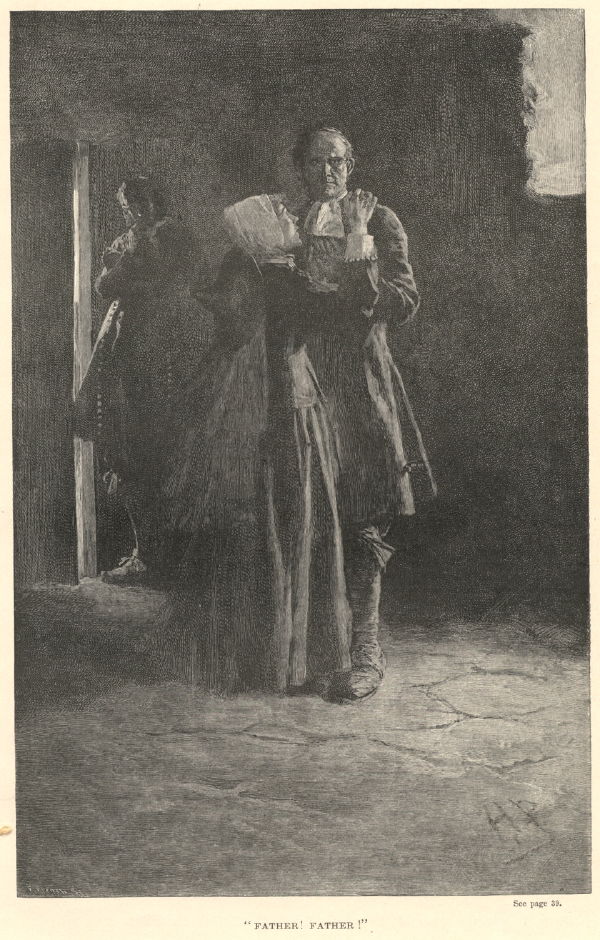
An illustration by Howard Pyle of an upright Corey, from Giles Corey, Yeoman


Another play about Corey, Mary Eleanor Wilkins Freeman's Giles Corey, Yeoman, appeared in 1893. Freeman's characters are duly impressed by Corey's fortitude, even if it is drawn from Old Nick. "Truly such obstinacy is marvellous!" one magistrate remarks, in such an "unlettered clown" and "old tavern-brawler."  Like Longfellow, Freeman portrays Corey as a principled man of good New England stock, presager to the region's great reformers and abolitionists of the nineteenth century, of whom only a few were brutally pressed to death by New England field stone.  

Corey also turns up in gravelly-voiced Marilyn Monroe beau Arthur Miller's famous play The Crucible (1953) -- as seen in the clip on the right from the 1995 movie.  Although John Proctor, played by Miller son-in-law Daniel Day-Lewis in the film version, is the real star of the play, Corey puts in a brief but memorable performance.  I'm sad to say, though, that neither the stage nor screen performances include any full-frontal nudity.  


Well, Courteous Readers, the end of the Ballad of Giles Corey draws nigh.  I hope this Puritan's moral resilience has inspired, or at least that his tale has amused.  Until next time, the Cabinet is closed.  

________________________________________________________


* I'm sorry to dash your hopes, but this punishment was not common in seventeenth-century New England, and Corey was the only person in colonial America to be pressed to death in this manner. This, of course, does not include the unfortunate printing press deaths connected with Boston resident Benjamin Harris. Look up, though! Its use was more widespread in Olde England, last employed in the 1740s. 


** From the diary of Samuel Sewall, a Salem witchcraft judge, early abolitionist, merchant, Harvard grad, prolific scribbler, and an all-around a real Mensch.  

11 March 2011

Curious Paintings by the Dutch Masters

If anyone truly knows anything about your modest and enigmatic Blogger, it is of my great enthusiasm for oil paintings from the seventeenth-century United Provinces of the Netherlands (AKA the Dutch Republic) and its culturally-poorer counterpart, the iron-lantern-jaw-ruled Spanish Netherlands.  

The famous Weberian Protestant aversion to sloth that produced the capitalistic madness of Tulipmania! also gave us those famous tobacco-loving Old Dutch Masters. Although today the feathery-haired Rembrandt of the Rhine or lazy pearl-loving lech Jan Vermeer are the perhaps the most well-known seventeenth-century Netherlandish artists, a whole host of lesser stars shone in the Dutch artistic firmament.  

And the Dutch liked to commission some weird pictures.  Maybe this had something to do with the high number of painters-per-capita in cities like Amsterdam and Delft.  Or perhaps it was related somehow to all those dams and dykes.  Most likely, though, it was because those damned Calvinists burghers had more slave trade profits, Javanese plantation guilders, and tulip credits than they knew what to do with -- so why not commission some unique art for your townhouse on the canal?

At any rate, here I present a sampling of said eccentric (to our modern eye) oil paintings, with a brief running commentary by this poor man's Simon Schama:


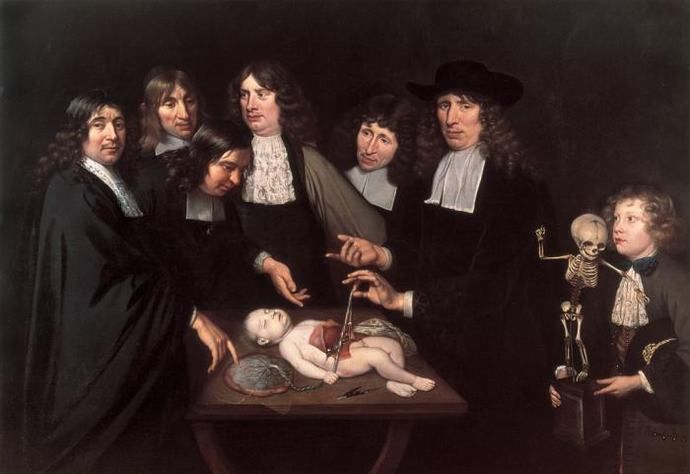
Anatomy Lesson by Dr. Frederick Ruysch, Jan van Neck (1634-1714), 1683.

Sure, the precipitous growth in medical and anatomical knowledge during the seventeenth century had to have been achieved through some pretty gruesome research, but...what the f**k?!?  I don't even know where to start with this one.  An anatomy lesson, with a baby?  A kid holding a baby skeleton?  If this doesn't prove the strange, foreign-countryness of the seventeenth century, then nothing will.  Also, I'm glad they're pointing at baby, because I WOULDN'T NOTICE IT otherwise!


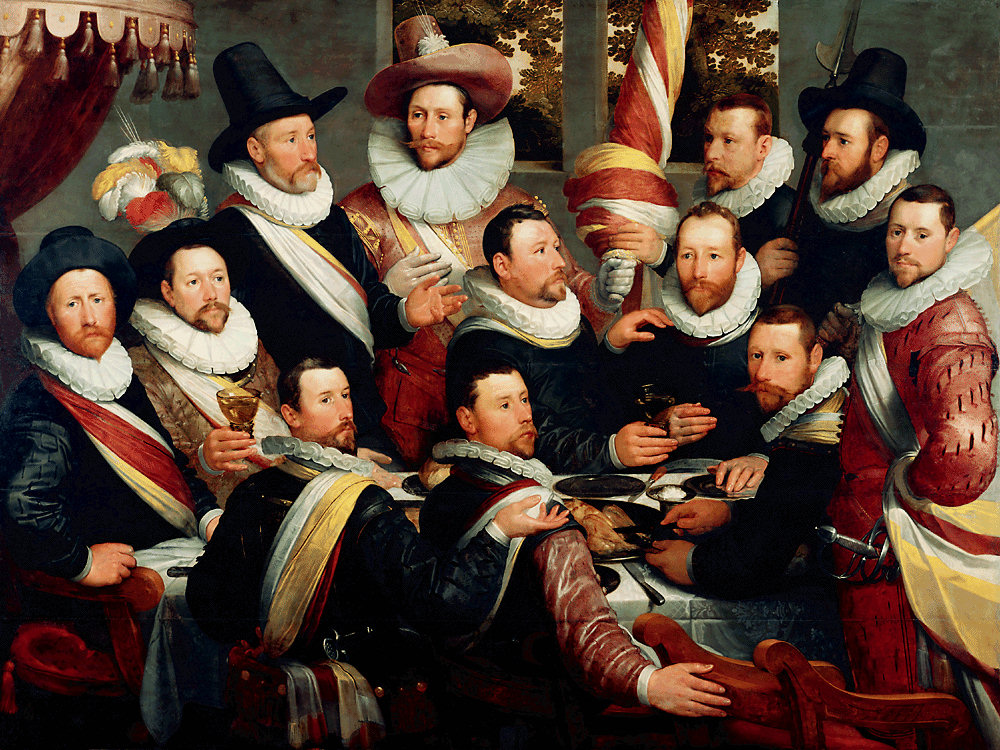
Banquet of the Officers and Subalterns of the Haarlem Calivermen Civic Guard, 
Cornelis van Haarlem (1562-1638), 1600.

The Dutch Republic was noted by its contemporaries for its problems with urban overcrowding.  That's why half of these guys packed up and globetrotted to New Ha(a)rlem a few years later.  I'm glad that's just a chicken on the table, though.  

But wait! This other van Haarlem is even straanger! 


The Fall of Lucifer, 1588.

This painting erroneously titled The Fall of the Titans until the 1920s.  Whether they Judeo-Christian or Greek mythological figures be, one can't help but notice those unfortunate butterflies covering the unmentionables of those fallen angels/future incubuses. 


Rich and Poor, or War and Peace, Unknown Artist.  

This biting social commentary is obviously from the Spanish Netherlands :(  Jeez, it looks like it was painted in 1409 -- nice use of perspective, international gothicist!  And if that's supposed to be different avatars of the same guy, you fooled me, unknown artist!

But wait! I (naturally) have several more bread-related paintings for your enjoyment:


A Baker Blowing his Horn, Gabriel Metsu (1629-67), 1660.

This baker looks pretty satisfied with his diverse output of breads, although his servant girl/wife in the back seems to be less impressed.  Get a load of that "horn of plenty," and notice those pretzels up on that early modern pretzel rack.

And take a look at this inferior baker-portrait copycat:


The Baker, Job Berckheyde (1630-93), 1681.

This baker's horn-blowing seems a little more labored, perhaps because his servant girl is out on the canal lollygagging for the young men.  And maybe he's upset because he has no cool ornamental bread loaf propped up on his counter or awesome blue-leafed botanical curiosity hanging above his head. 


Still Life with Dog and Cat in Front of a Lobster, Jan van Kessel the Younger (1654-1708), c. 1690.

The Dutch turned the still life painting into high art, although I don't know if a scene with so many living, almost living, or boiled animals qualifies as a still life OR fine art.  This is, in fact, one of a series of three (that I can find) still life paintings of weird seafood by van Kessel.  I guess the demand was high for lobster-on-Delftware scenes. Some other (real!) van Kessel favorites include Two Cats Playing with Fish (below), Monkey among Fruit, and Dwarfs with a Dog (also below).


*     *     *


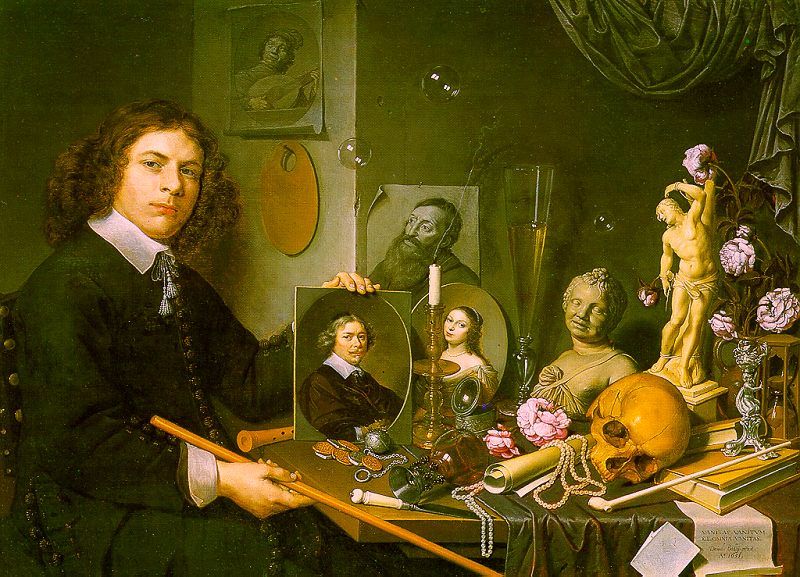
Self-Portrait with Vanitas Symbols, David Bailly (1584-1657), 1651.

Those predestination-obsessed Calvinists sure liked their vanitas (reflections on the transitory nature of life and constant presence of death) paintings. But most vanitas scenes did not have (non-skull) people in them, let alone people holding paintings of old guys (or dowel rods, or long clay pipes, for that matter)!


Here's another strangely personal vanitas portrait:


Vanitas Portrait of the Painter, Antoine Steenwinkel, Date Unknown.

Steenwinkel had so little vanity that I can find little or nothing about him or this painting in my vast reference library (organized using the Cotton system).  I'm not sure if the guy holding the painting-in-a-painting is supposed to be the artist (or, indeed, the same person whose skull sits on the table).  "Like sand through the hourglass, so are the (short) days of our early modern lives."

And here's another painting-in-a-painting:


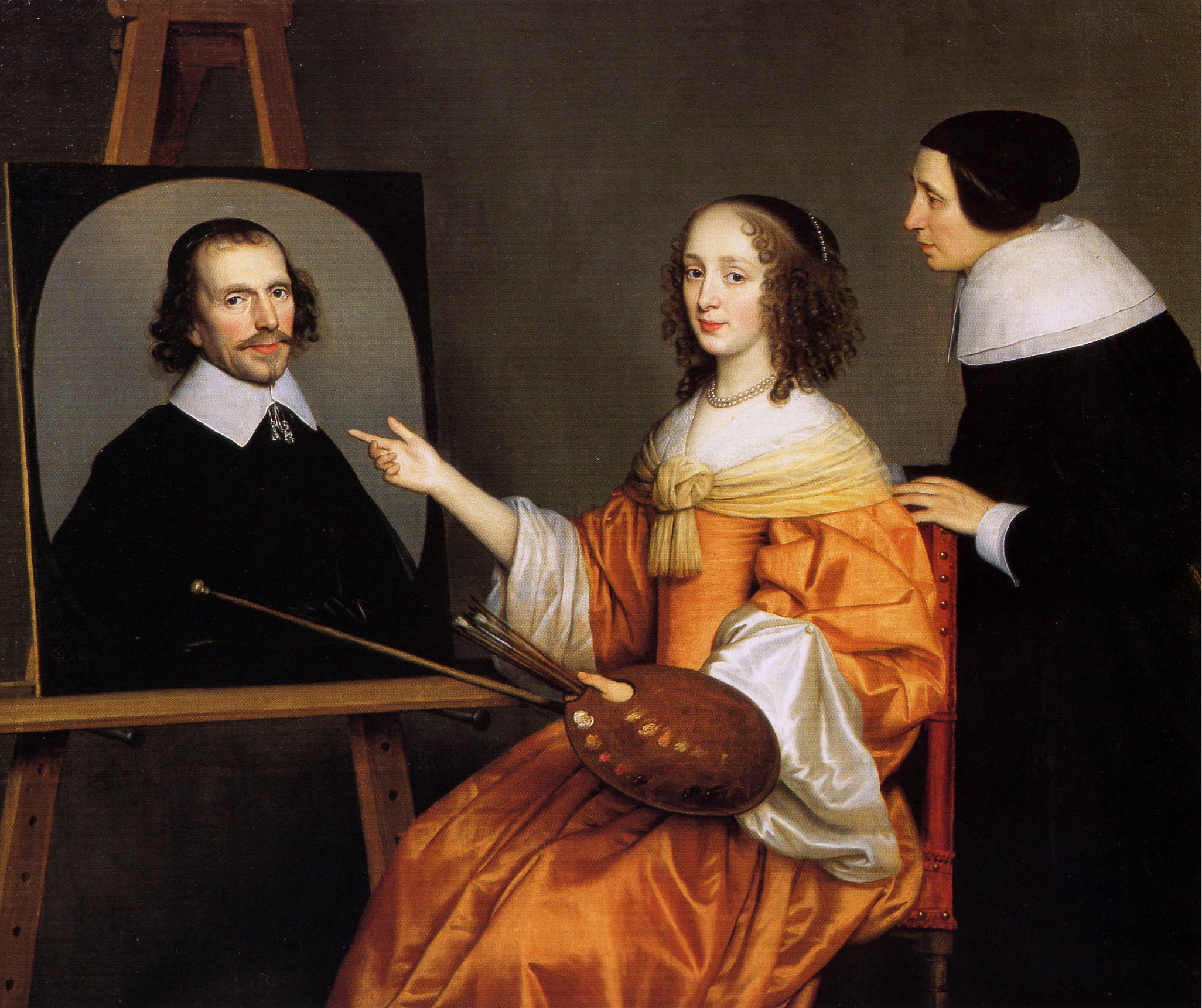
Margareta Maria de Roodere and Her Parents, Gerard van Honthorst (1592-1656), 1652.

What to do when you want a family portrait, but one of your parents has gone to (fingers crossed) join the Elect in the sky?  Have your artistically-inclined daughter paint a portrait of her father from memory and then commission another, superior male artist to paint the whole gang! Also, those Dutch really enjoyed pointing at obvious things.

The following is another great van Honthorst specimen:


The Concert, 1624.

Whoa, check out those buxom lutists! I'm not sure what the baby-angels with laurels in town are contributing to the concert, however. 


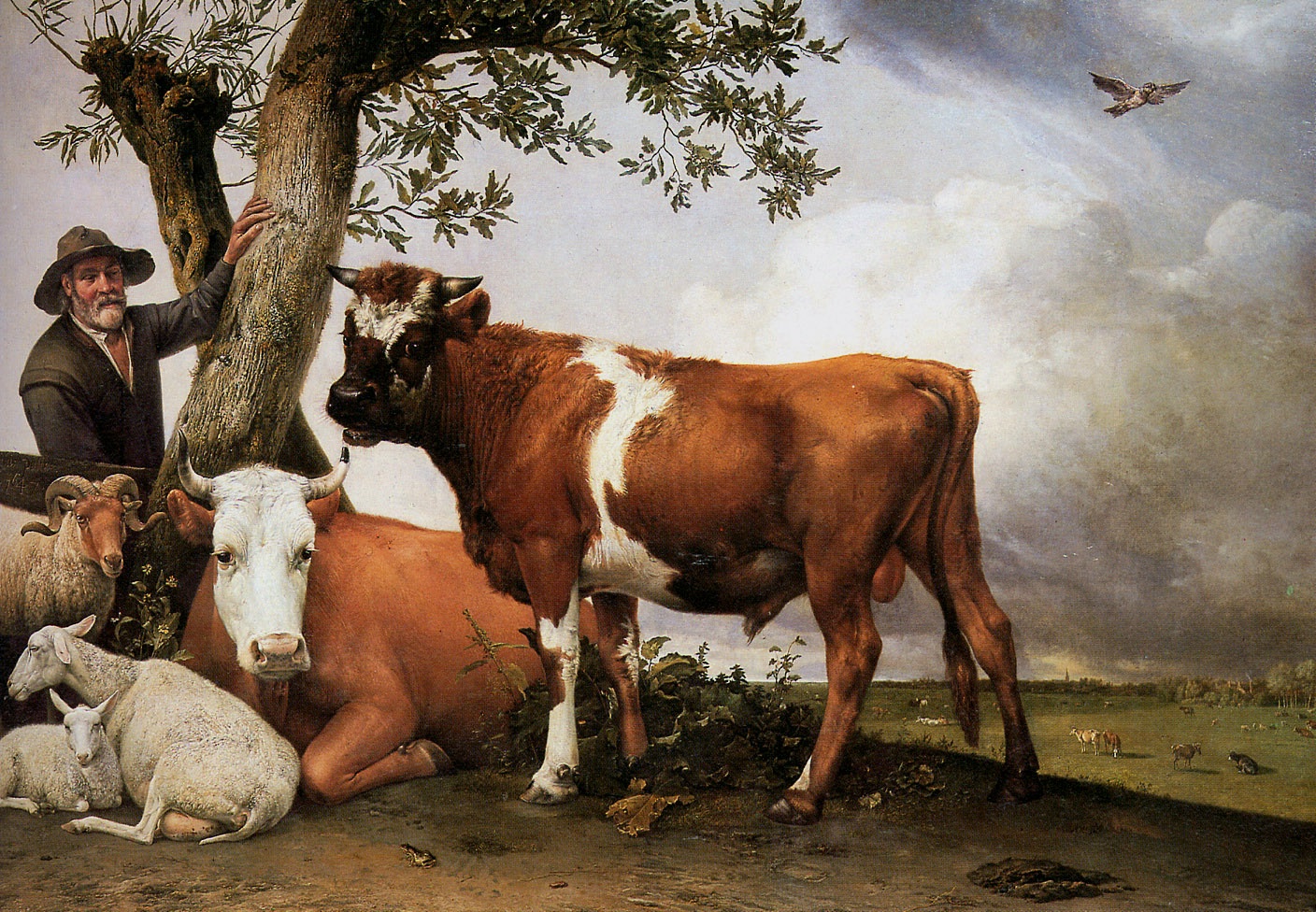
The Bull, Paulus Potter (1625-54), 1647.

I've heard tell that the bull at the center of this interesting pastoral scene was anatomically impossible, exhibiting characteristics of several breeds and different ages of cow-maturity.  But I'll trust the Gorton's fisherman on the left, who doesn't seem to mind his anachronistic menagerie too much. 


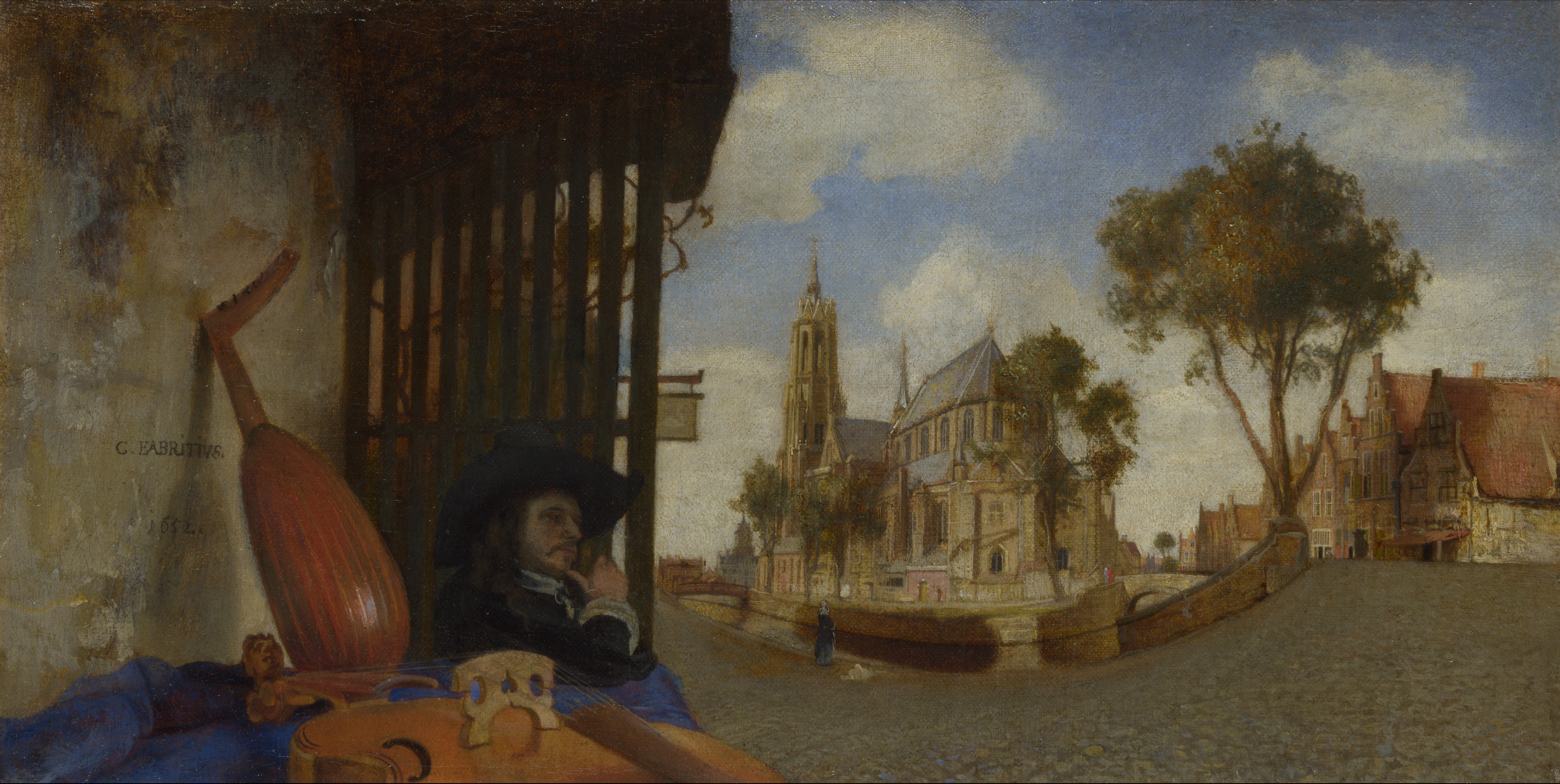
A View of Delft, with a Musical Instrument Seller’s Stall, Carel Fabritius (1622-54), 1652.

This Rembrandt protege meant for his curious painting to be viewed mounted on a curved surface to fully enjoy this experiment with perspective.  Despite what our earlier piece The Concert might lead you to believe, it doesn't seem as if this lutemonger is doing too much business in Bizarro-Delft.


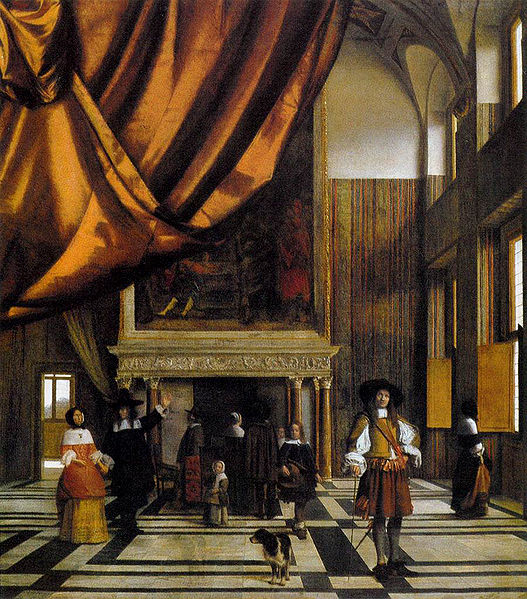
The Council Chamber in Amsterdam Town Hall, Pieter De Hooch (1629-84), 1665.
(Or, Scene with Giant Ominous Curtain)

Finally, we have this group portrait, where we see, among other things, yet another (partially obscured) painting-in-a-painting.  Although this is a council chamber, not much business seems to be getting done, perhaps because everyone is staring at the huge curtain floating above their heads.  

*   *   *

Well, art-lovers, its time this Sister Wendy retired to her cloister to prepare another fact-filled gallery tour.  I hope you've enjoyed our little trip through the Dutch Golden Age. Until then, the Cabinet is closed.

04 March 2011

Doctor Lambe, the Duke's Devil


"[Doctor] Lambe Stinkes worse than Mackerall or Haddocke," 
wrote one master of Jacobean light verse.  

I present to satisfy your curiosity, dear readers, the tale of the seventeenth-century astrologer-magician-physician John Lambe, a self-styled "Doctor" who numbered among his clients the most powerful man in England, George Villiers, 1st Duke of Buckingham, favorite of Stuart kings James I and Charles I.  

Born around 1545, little is known of Lambe's life before he came to London to ply his trade as conjurer-at-large.  He seems to have been a tutor to gentlemen's sons in Worcestershire, afterwards studying medicine.  But, as young medical students are wont to do, Lambe soon fell prey to "other mysteries, as telling of fortunes, helping of divers to lost goods, shewing to young people the faces of their husbands or wives that should be in a crystal glass."

Lambe was arrested in 1608 in Worcestershire for practicing his new profession, charged with disabling the physical and mental strength of and "generalley givving bad Vybes" to Thomas, Lord Windsor, and accused of invoking and entertaining "certain evil and impious spirits."  While being held, he proved to several visitors that he could cause apparitions to proceed from his crystal ball. He also prophesied death with fatal success, with some forty people that had been present in court dying within two weeks of the trial (probably just an outbreak of gaol fever, now called typhus :( ).  

Worcesterites successfully, and understandably, lobbied for Lambe's transfer to London's King's Bench prison, where he lived there in easy confinement, occupying two rooms, employing servants, and practicing "medicine" as before.  Indeed, in his heyday as a physician in London, Lambe claimed he could conjure spirits, find missing items with his crystal ball, treat maladies, exorcise witchcraft, and "do dirtey Deedes" cheaply.  

One of his client-visitors at the prison was Buckingham, always on the lookout for an easy anecdote when his fortunes waned at the Royal court. On June 12, 1626, London was hit by an unexpected storm, after which a mist hung over the River Thames near York House, Buckingham's residence. The superstitious, and Buckingham-haters, discerned ominous shapes in the fog, including a skull, a horse, and a giant lace collar. Lambe had appeared on the river earlier in the day, and many attributed these fearful meteorological disturbances to his conjuring. Buckingham's mother, though to be practitioner of the "cunning arts" herself, said she saw in Lambe's crystal ball the shadowy figure of a large man holding a dagger, poised to kill her son.  Needless to say, things didn't look good for either of our boys.  


John Lambe's patron, the Duke of Buckingham, who reputedly had his astrologer summon angels, naked children, and Greek sea gods for his enjoyment.  

Because of his perceived control of Buckingham, Lambe was slandered widely, in alehouses and in print. Broadsheets of the day called him things like the "Foole Lambe, that lewde Impostar," and Lambe was known widely as "the Duke's Devil."  A popular chant (and lullaby) went thus: "Who rules the Kingdom? The King. Who rules the King? The Duke. Who rules the Duke? The Devil!"

Public opinion against Lambe and the Duke became so negative that, by 1628, the octogenarian feared for his life.  Curiously enough, Lambe began his last evening, Friday the 13th (!) of June, attending an entertainment at an open-air theater called the Fortune (!) playhouse. There, he noticed a gang of "never-do-weles" and young punks making threats on his life and giving him the stink-eye.  The angry crowd followed him to dinner at a tavern, despite the sailor-bodyguards he had hired for the evening. He ducked into the Windmill Tavern, then hid a friend's house nearby. His naysayers surrounded both hideouts, demanding with thrown stones that Lambe be released to them. Eventually, kicked out onto the street, the crowd had their way with the old conjurer, assaulting him with stones and beating him with cudgels until no part of his body "was left to receive a wound," according to one witness.  Lambe was carried to the nearby Counter prison, where, despite desperate attempts at magical intervention, he died the next morning.  

Constables failed to locate any of the murderous mob, and no one was ever punished for Lambe's death. Many alleged this slight of justice, and law enforcement's failure to prevent the crowd setting upon the hated physician, was intentional. London mobs chanted, "Let [King] Charles and George [the Duke] do what they can, the Duke shall die like Doctor Lambe!" Lambe's patron was assassinated less than two months later by one of his former officers while dining in a Bristol tavern on the eve of his military expedition to France.  


A woodcut from the front of the broadside ballad The Tragedy of Doctor Lambe (1628). I'm guessing that's an evil demon, incubus, spirit, succubus, or the like conjured by Lambe on the lower-right.  


From the back of the same.  Apparently, Lambe was a Catholic monk who liked hiding under tables.

Crowds came (and paid) to see Lambe's body at the Counter prison. It was reported that Lambe had a strange assortment of items on his person when he died, as befitting an astrologer-physician. These everyday needs included a sword, knives, a crystal ball, a gold nightcap, twelve silk pouches, forty shillings, and eight small engraved portraits, including that of the Countess of Somerset, a favorite at court, an alleged witch and pardoned murderess.  


England was flooded with printed satiric commemorations, anti-tributes, and scandal-rags in prose and verse after Lambe's murder, remaining as popular a topic for discussion in death as he was in life. One balladeer, in The Tragedy of Doctor Lambe (1628), wrote of Lambe's death:

"Neighbours cease to moan,
And leave your lamentation,
For Doctor Lambe is gone,
The Devil of our Nation."

Another eulogized, in An Epitaph on Dr Lambe:

"Here Dr Lambe, the conjurer lyes,
Against his will untimely dies.
The Divell did show himselfe a Glutton
In taking this Lambe before he was mutton."

*     *     *
So, readers fair, here endeth our tale of the notorious life and ignominious death of Doctor John Lambe, infamous conjurer, passable early modern physician, and the face that launched a thousand hackneyed broadsides.  Until next time, the Cabinet is closed!  

28 January 2011

The Russian Ben Franklin, Михаи́л Ломоно́сов


In addition to being a poet, astronomer, chemist, and general layabout, Lomonosov mastered the art of the no-look diary entry.  

Hello, Cabinet patrons! In this installment, I bring you the story of Mikhail Vasilyevich Lomonosov (1711-65), Russia's answer to Benjamin Franklin and Johann Wolfgang von Goethe -- father of Russian science and poetry and all-around Mensch.  

Lomonosov grew up on the shores of the White Sea on Russia's northwest coast, the son of a fisherman and descendant of the Pomor settlers in the region. No quick study at fishing, in 1730, at age nineteen, Lomonosov struck out for the big city, Moscow.  He was admitted to Russia's Harvard, the unfortunately-named Slavic Greek Latin Academy, completing a twelve-year (!) degree in five years.  Later, he was able to study chemistry and mining for two years in Germany at the University of Marburg.  There, Mikhail picked up the German language, picked up a German wife, Elisabeth Zilch, and picked up a svengali, the eminently-named philosopher, Christian Freiherr von Wolfius.  


Lomonosov's chemistry lab/breakfast nook.
(Northwestern Univ.)

Returning to Mother Russia in 1741, Lomonosov taught physicks and chemistry at the Russian Academy of Science, where he encouraged his students to call him "Doc Lommy" and "Teach." He inspired young mind at the RAS until 1755. (Except for a short interlude in 1743, during which he was house arrest for personally insulting several prominent faculty members!)  Lomonosov left the RAS to found the venerable Moscow State University (MSU), now also known as the Lomonosov Memorial Moscow State University.  


Sketches by Lomonosov of the Northern Lights. Reportedly, his students marveled at his chalkboarding expertise.
(Northwestern Univ.)

Lomonosov was a true polymath during a century of great Renaissance (well, not that Renaissance) men (and women).  Here's a sampling of some of his many interests and achievements:
  • An enthusiastic amateur astronomer, he hypothesized the existence of Venus' atmosphere, which prompted Czarina Elizabeth to christen the planet "New Siberia."
  • He made major improvements to the telescope, co-inventing what is now known as the reflecting or Herschelian telescope, a "window on the West," which, on imperial decree, he used to spy on the various palaces of the absolute monarchs of Europe.  
  • He published a catalog of over three thousand minerals in 1745, later a popular source for light readings  and entertainments at St. Petersburg's Paris-style salons.  
  • Lomonsov organized an expedition, helmed by Vasily Chichagov, to find the Northeast Passage sea route between the Atlantic and Pacific Oceans. Wisely, Lomonsov avoided actually going on this ice-hampered journey through the Frozen North.  
  • He was also a prolific mosaic artist! He set up a glass factory to produce the materials for his forty giant mosaics, most commemorating Great Moments for the Fatherland. 
  • A venerable writer, Lomonosov wrote a history of Russia, and reformed Russian poetic language, producing a reformed grammar combining vernacular Russian with Old Church Slavonic, an innovation he used to write several poetic works.  His "Ode to Carolus Linnaeus' New Genus-Species Classification System" was written for performance on his election into the Royal Swedish Academy of Sciences in 1761.  
  • He was also interested in icebergs, the properties of mercury, organic chemistry, bejeweled eggs, optics, continental drift, and wig design!


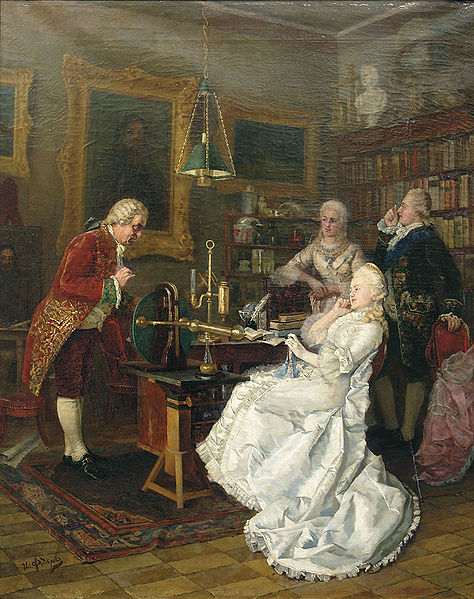
Russian empress (and amateur natural scientist and animal husbander) Catherine the Great visits Lomonosov in 1764.  (Ivan Fyodorov, 1884)

Lomonsov is still a big deal in Russia, seen as the man who brought the ideas of the Western European Enlightenment to darkest Russia.  He is to science what Puskin is to Russian literary culture or Rasputin is to well-endowed hemophilia-curing mystics. 

Let's have a trio of huzzahs! (or Ура's!) for Mikhail Lomonsov!  

22 January 2011

The Great Frost of 1709


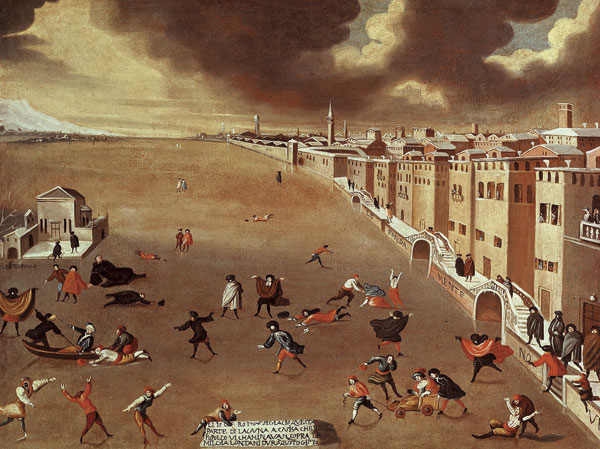
A painting of Venetians frolicking and lollygagging on the city's icy lagoon, frozen over by the harsh winter of 1709. Members of the city's gondoliering guilds still recall despairingly that horribly unprofitable fiscal year.

In this bleak midwinter of 2011, I bring you the heartwarming tale of a winter past, that of 1709. Remembered as The Great Frost in England and The Great Winter in France, Europe experienced an icily frozen spell thought to be the continent's coldest winter of the last five hundred years.  


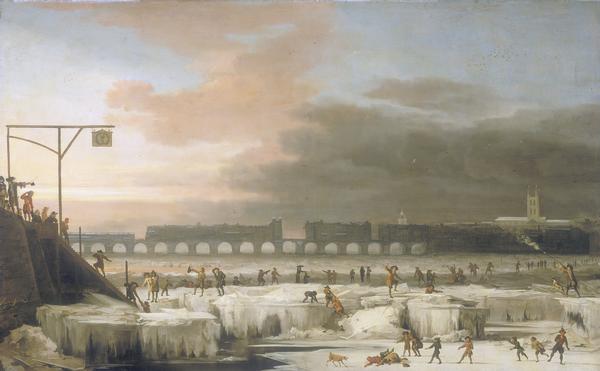
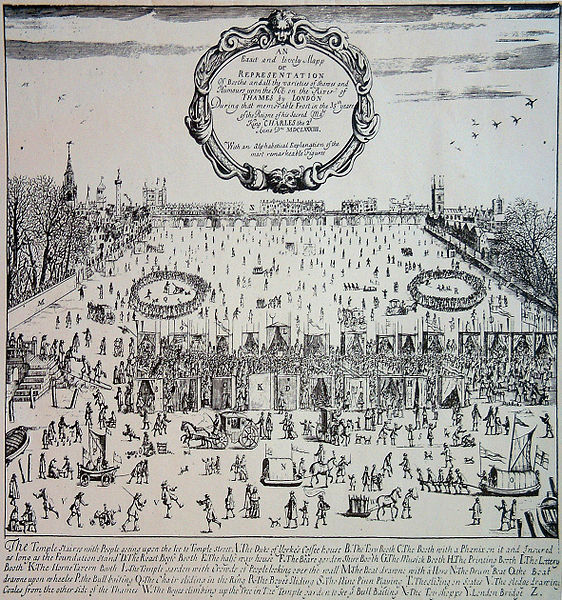
The Frozen Thames, 1677.  

The great London waterway "The River Tims" froze over several times during the seventeenth and eighteenth centuries. It has not frozen since 1814, however, perhaps because of some Napoleonic plot to sabotage the popular winter carnivals held on the ice-covered river and demoralize the British public.  


A depiction of one of the infamous "Frost Fairs" held on the Thames from 1608 to 1814.  Although drunken revelry and frivolous celebration ruled the day, many lost body parts from frostbite and suffered death-by-hypothermia (not to mention the aggravation it caused gout-sufferers).  

Church of England clergyman William Derham (1657-1735), who moonlighted as a natural philosopher, wrote that he believed the Frost "greater, if not more universal also, than any other within the memory of Man." He recorded temperature readings as low as -10 degrees Fahrenheit (250 Kelvin, for our non-American or Liberian readers).  It is estimated that 600,000 people in France starved to death, forced to subsist on cake because of the failed winter wheat crop.  The soil, many reported, froze to a depth of three feet, and large bodies of water, like the Baltic Sea, the Venetian Lagoon, and the reflecting pool at Versailles, also turned to ice. 


Part of fear-inducing modernist Virginia Woolf's 1928 novel Orlando is set against the backdrop of The Great Frost. Woolf would appreciate the warmer winters of  post-Little Ice Age Britain during her 1941 "Ophelian swim."

Several stories about the extreme cold that winter have survived. It was said that trees exploded because of the low temperatures! Loaves of bread froze so thoroughly that it took an ax to cut it! People reported that their nightcaps (standard-issue attire in the eighteenth century) froze to their headboards overnight! Livestock froze to death in their barns and coops (which makes one wonder why all those French people starved to death with all that meat around)! King Louis XIV became mildly uncomfortable for several hours at Versailles on the 18th of January!


Fun in the snow! (I think that might be an exploded tree at lower-center.)

I hope this tale of winter long ago indeed has warmed the cockles of your heart. Now, brave the frosty air of your northern climes, and be glad nightcaps and unsliced bread are now passé!

Related Posts Plugin for WordPress, Blogger...